Introduction #
Boost Call Center Performance with 3CX Competitive Wallboard: Real-time Agent Rankings and Motivation
Keep your team motivated with a live view of agent performance and rankings in one easy-to-read dashboard.
3CX Competitive Wallboard helps managers spot top performers and track progress toward goals without constantly checking reports. Agents can also see how they’re doing in real time making it easier improve throughout the day. Because everything updates live, your team always knows where they stand whether they’re chasing quotas, improving response times, or aiming for the top spot on the leaderboard.
Simple, visual, and easy to follow, it’s a practical way to keep your call center engaged and moving forward.
What is 3CX Competitive Wallboard? #
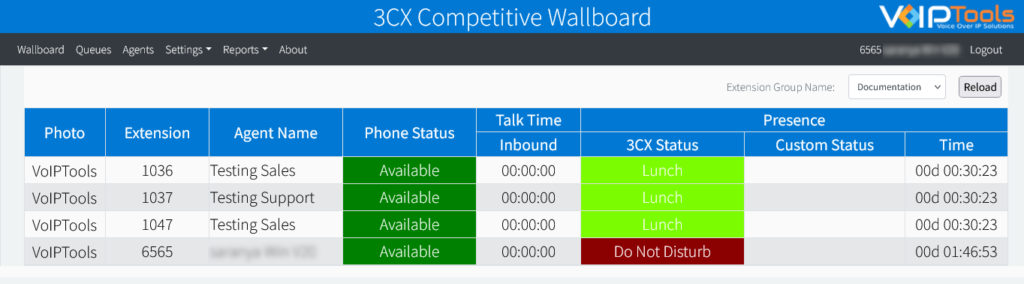
The 3CX Competitive Wallboard gives your team a live leaderboard that shows how agents are performing throughout the day, week, and month. Managers can choose which stats to display and set team goals that match their workflow. This makes it easier to recognize strong performance and spot trends early. Agents only see the shared leaderboard information, so personal data stays private while still giving everyone a clear idea of how they compare and where they can improve.
Over time, the wallboard also helps managers track performance trends and make smarter decisions based on real activity, not guesswork.
Why choose 3CX Competitive Wallboard? #
 |
AGENT PERFORMANCE | Identify top-performing agents who have achieved the highest call volume and recognize diligent agents who have met their call targets for the current month, week, and day. |
 |
MANAGEMENT VISIBILITY | Gain valuable insight into your team’s productivity as a manager. Identify top performers and those in need of support instantly, empowering you to optimize performance and make informed decisions in real-time. |
 |
ENHANCED ACCOUNTABILITY | Access tangible and practical data instantly, enabling informed decision-making based on crucial performance metrics. |
 |
AGENT STATUS | Monitor the availability and duration of phone status changes in real-time. |
Prerequisites #
Before installing 3CX Competitive Wallboard, you need to ensure that your computer meets the minimum requirements mentioned below:
| PREREQUISITE | PURPOSE |
|---|---|
| 3CX Version V20 | 3CX Competitive Wallboard is designed to work seamlessly with this version for enhanced features and performance. |
| Windows 10 or above / Windows Server 2012 or above | These operating systems provide the necessary environment for the application to run efficiently. |
| IIS Features and Configuration – VoIPTools | IIS is needed as a web server to host and manage web-based applications and services. |
| .NET Framework 4.7.2 (Web Installer) | This framework provides essential components for running and developing applications. |
| .NET Core SDK. | .NET Core SDK is required for development and deployment purposes. It provides the necessary tools, libraries, and runtime environment for building and running .NET Core applications. and allows developers to create custom integrations, plugins, or extensions for the 3CX system. Click here to download the application and install it in the VoIPTools server. |
| VoIPTools Universal Updater | This component is necessary for updates, ensuring the application remains current and functional. |
| VoIPTools Relay Service | It is used for proper integration and functionality of the 3CX Competitive Wallboard within the 3CX environment. |
| Microsoft SQL Server 2016 or above (Including the free SQL Express edition) | 3CX requires Microsoft SQL Server 2016 or later for database management. |
| Minimum of 8GB RAM | Sufficient RAM ensures smooth performance and efficient operation of the 3CX Competitive Wallboard software, especially when handling large amounts of data. |
| Static IP for VoIPTools and 3CX servers | This is to ensure proper two-way communication, both the 3CX server (Relay) and the VoIPTools server. Dynamically assigned IP addresses are not supported. Additionally, it is recommended to use HTTPS for secure communication, which requires a FQDN for SSL/TLS certificate validation between the VoIPTools server and the Relay. |
| Port number 7250 opened on your device | Port 7250 is a specific network port used by 3CX for communication purposes. Opening this port on the device’s firewall allows incoming and outgoing traffic to pass through, enabling the 3CX software to send and receive data over the network effectively. |
NOTE:
- Installation on a domain controller may require additional assistance
- When installing SQL Server, we recommend you install it in “Mixed Mode” to include SQL Authentication, and install SQL Management Studio
- When installing IIS, be sure to install Basic Authentication, .Net Extensibility, and ASP.Net 4.X
Installation overview #
 |
DOWNLOAD SOFTWARE | You can order 3CX Competitive Wallboard online at https://www.voiptools.com. Your order confirmation email will include your license key and a link to download the software. |
 |
INSTALL PREREQUISITES | You must install several prerequisites before installing the 3CX Competitive Wallboard. The Advanced Installer identifies and installs these applications automatically. Click here to learn about the required prerequisites. |
 |
INSTALL 3CX COMPETITIVE WALLBOARD | This User Guide contains step-by-step instructions to successfully install 3CX Competitive Wallboard. Begin by extracting the installer from the downloaded zip file, then run the setup program named CompetitiveWallboard.exe |
 |
LOG INTO THE WEB APPLICATION | You can now log in to the web application using the extension number and the PIN. |
Step-by-Step Installation Procedure #
The following section will guide you through a detailed walkthrough of the installation process.
Step 1: Download 3CX Competetive Wallboard #
Find the software download link in the Order Confirmation Email, or you can download the application by following the procedure,
- Open your browser and go to the VoIPTools official website or click here to get redirected to the website.
- Search for Competitive Wallboard and click the Download
 button to download your application.
Step 2: Install Prerequisites #
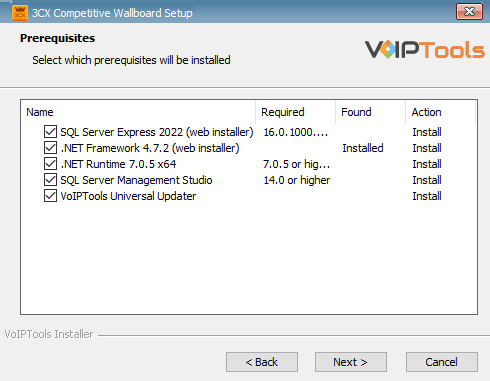
Click on the software installer that was downloaded in step 1 above. The installation wizard will automatically identify the needed prerequisites and assist you with the install of the prerequisites needed to run ‘3CX Competitive Wallboard’. These include .NET Framework (Web Installer), SQL Server Express (Web Installer) and, SQL Server Management Studio.
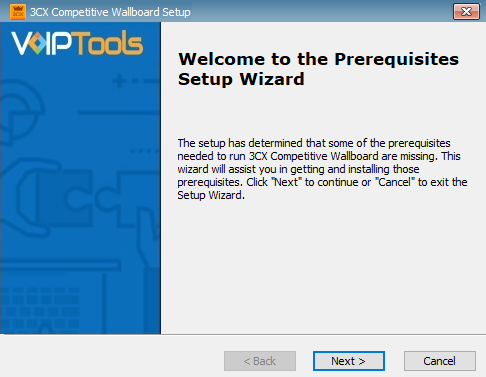
- Click the downloaded installer executable to launch the Prerequisites Setup Wizard and click Next.
- In the Prerequisites window, the installer will identify the missing prerequisites. It is important that you install all the required prerequisites. However, you can select/unselect the applications to be installed based on your unique requirements. Click Next to continue.
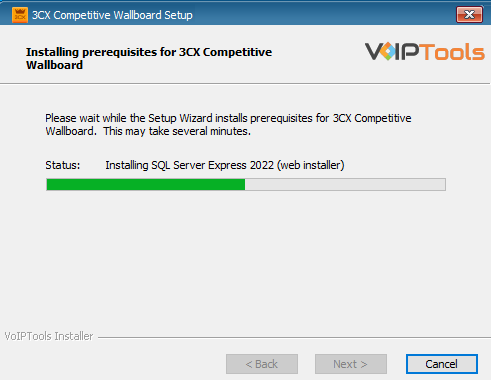
The installer will download and install the selected applications.
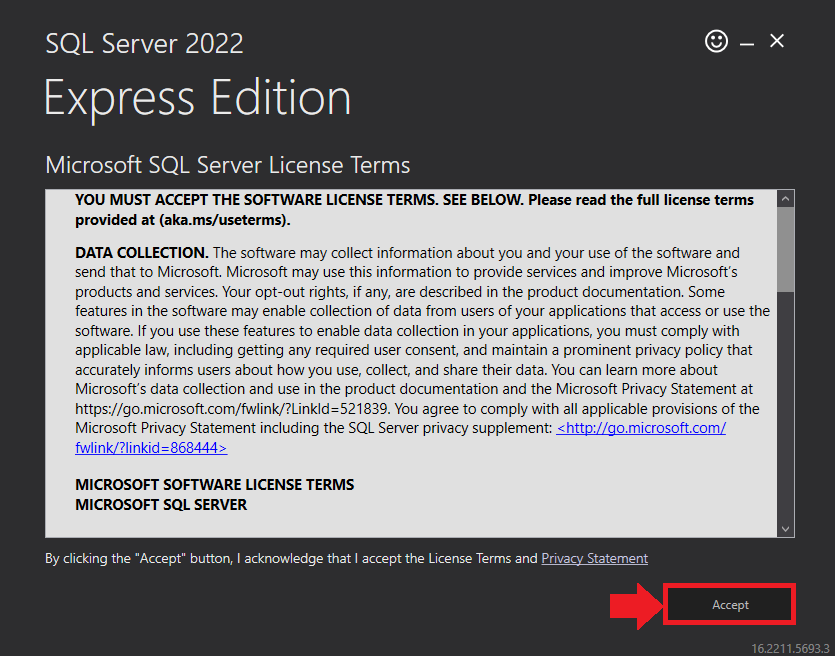
- In the Microsoft SQL Server License Terms click the Accept button to acknowledge the license terms and continue.
- This page appears if you do not have SQL Server Express preinstalled in your device.
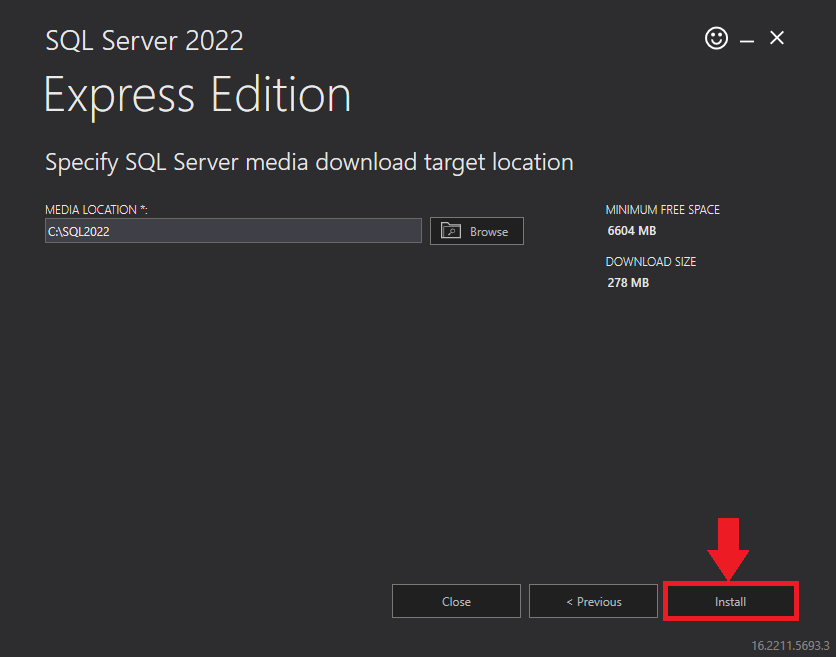
- View the SQL Server Media target location in the Media Location field. If required, you can click the Browse button to change the location. Click Install to begin the installation of SQL Server Express.
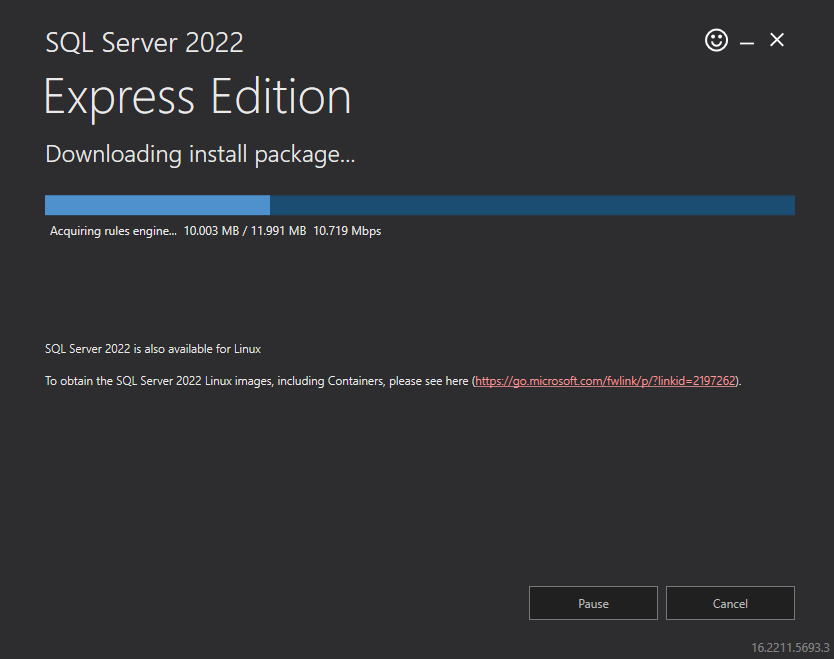
SQL server installation is in progress. This may take several minutes to complete.
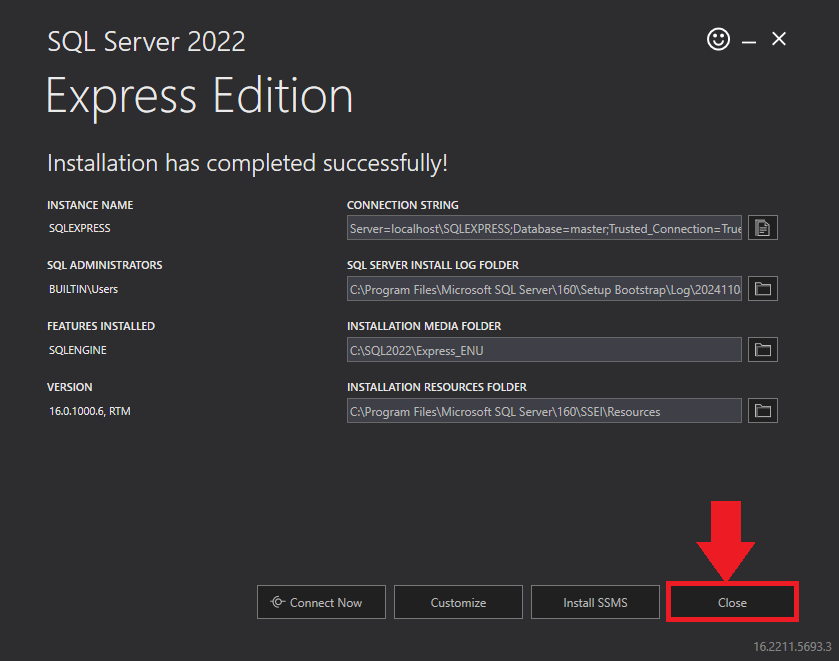
- Click the Close button once the prerequisites are installed.
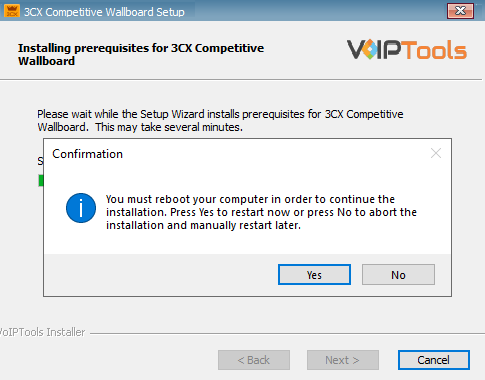
- During the installation of SQL Server Management Studio, you will again be asked to reboot your computer. Click Yes to reboot the computer.
Step 3: Start the installation process #
-
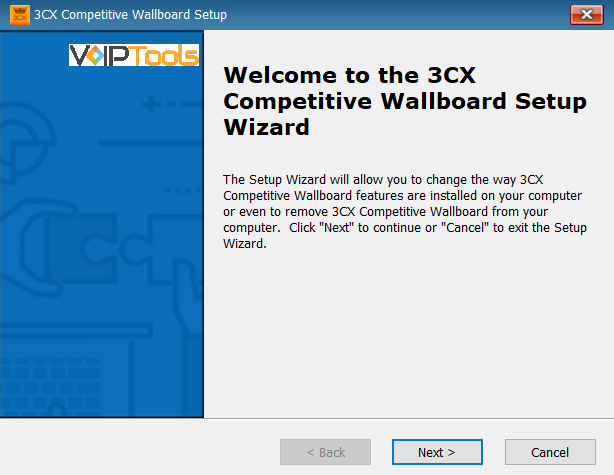
- After all the prerequisites are installed, the 3CX Competitive Wallboard Setup Wizard appears. Click Next to Continue.
-
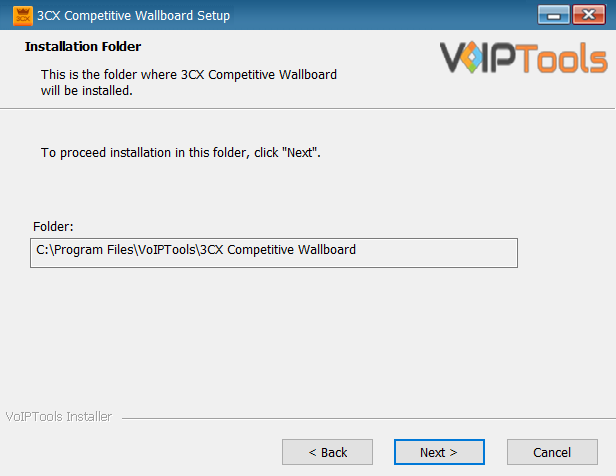
- On the Select Installation Folder window, the Folder field displays the location where the ‘3CX Competitive Wallboard’ will be installed. Note that you cannot change the path.
-
- Click Next to continue with the installation.
Step 4: Test Relay Settings #
-
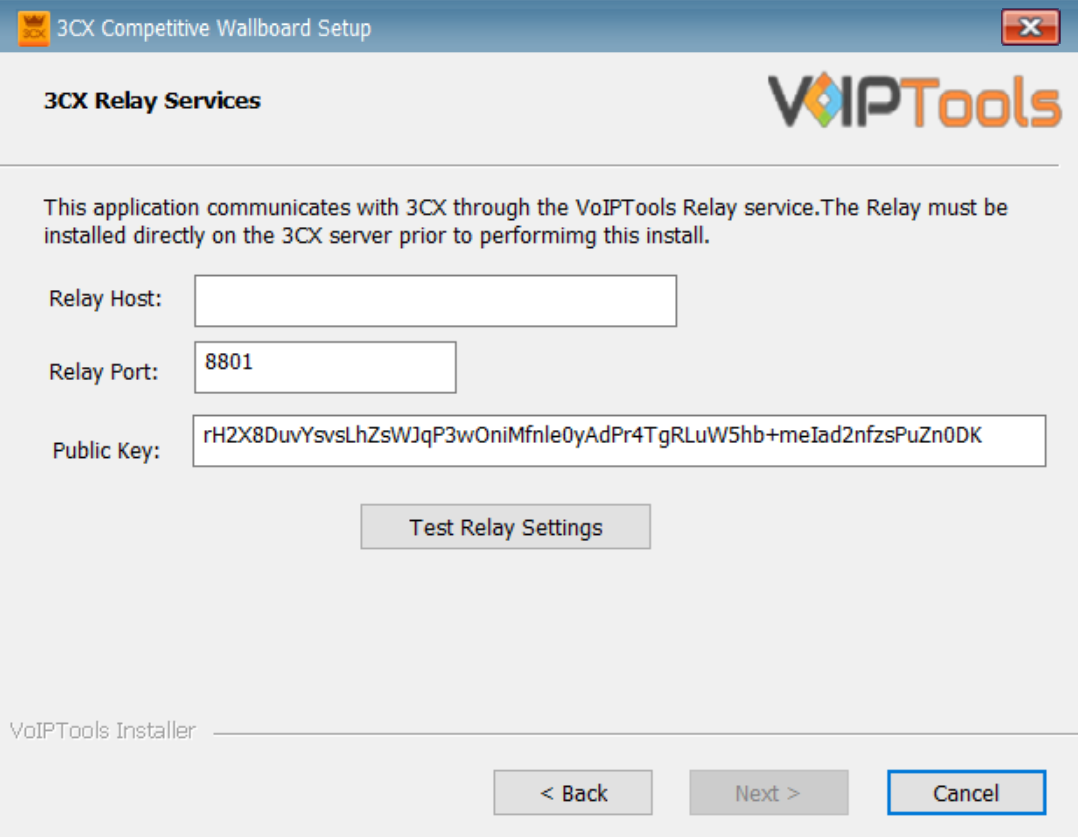
- In the 3CX Relay Services window, in the Relay Host field, enter the FQDN of your 3CX server.
-
- Enter 8801 in the Relay Port field.
-
- Enter the public key you took from VoIPTools Relay services in the Public Key text area.
-
- Click the Test Relay Settings to confirm ‘3CX Competitive Wallboard’ can communicate with the Relay services running on the 3CX server.
-
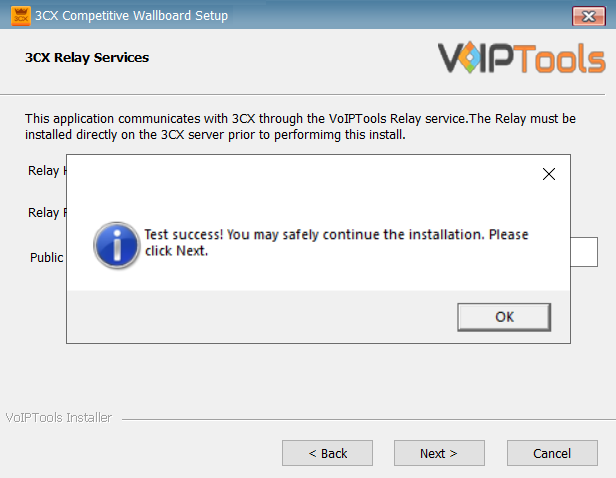
- If the ‘3CX Competitive Wallboard’ is successfully able to communicate with the Relay services that run on the 3CX server, a Success message box appears. Click OK. If the test fails, you will not be able to continue until communication with the relay is established.
-
- Click Next to continue with the installation.
- You must set the Relay Port to 8801.
- If the Relay test fails, you cannot continue the installation until you establish communication with the Relay. If the test was unsuccessful,
- Confirm you have the correct firewall port open (default TCP 8801) on the 3CX server and the firewall protecting the 3CX server.
- Confirm that you have entered the correct FQDN for the 3CX server.
- Confirm that the 3CX Auto Logout and Relay use the same port and protocol.
Step 5: Configure the database #
When configuring the 3CX Competitive Wallboard, select an existing Microsoft SQL Server instance in your environment. The database server can be a remote SQL Server, or a local instance running on the VoIPTools server.
You can set up the SQL database using SQL Authentication or Windows Integrated Authentication.
SQL Authentication #
-
- Enter your server name in the Server field.
-
- If using the free SQL Express Edition, the default SQL Instance name is SQLExpress.
-
- Enter your server name in the Server field.
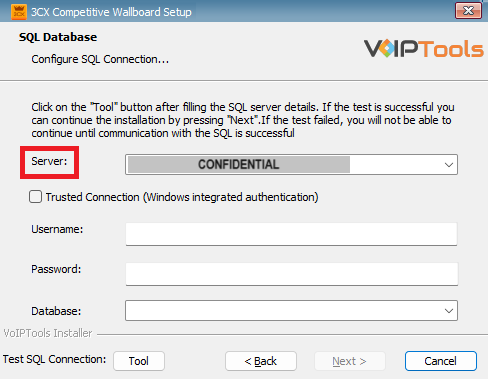
- If you want to use ‘SQL Authentication’, then install SQL Server in ‘Mixed‘ mode.
- If SQL Server is installed on a server other than the server where 3CX Exporter is installed, you will need to configure SQL Server to allow remote connections.
-
- Enter your credentials in the Username and Password fields.
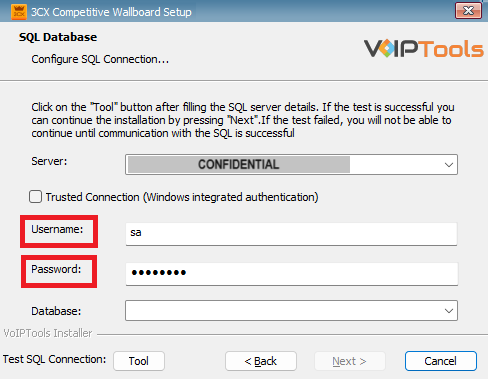
Make sure that you select a SQL Login that has sufficient permissions to alter the database and create SQL objects.
-
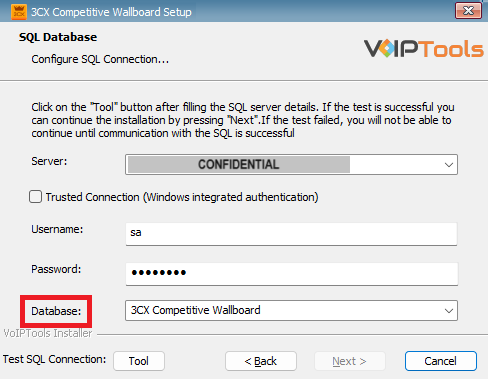
- Select or enter the 3CX Emergency Notifier in the Database dropdown.
-
- In the Test SQL Connections section, click the Tool button to test the connection and click OK in the Test Results popup box.
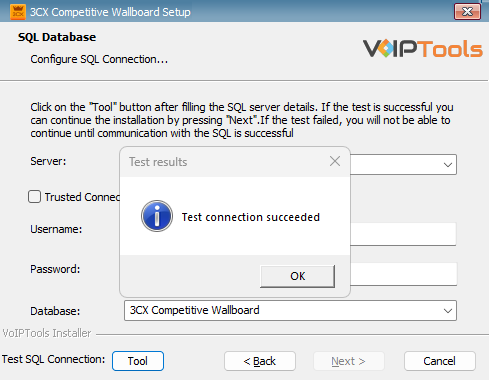
Windows Integrated Authentication #
-
- To use Windows Integrated Authentication check the Trusted Connection (Windows integrated authentication) checkbox.
-
- The VoIPTools installer will create a local Windows user name as “VoIPToys” and give you sufficient rights to this user to create/update the SQL database.
-
- To use Windows Integrated Authentication check the Trusted Connection (Windows integrated authentication) checkbox.
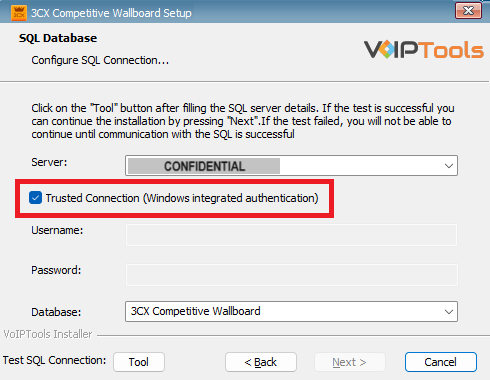
-
- In the Test SQL Connection section, click the Tool button to test the connection.
-
- Click the Next button that gets enabled when the database connection is successful.
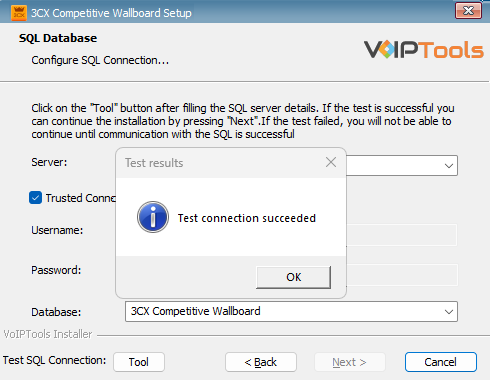
We encourage you to use SQL Authentication rather than Windows authentication. Many of our tools leverage a Call Flow Designer (CFD) application running on the 3CX. Frequently our CFD applications require access to a SQL database. If the 3CX server and the database server are not in an Active Directory domain, Windows authentication will fail. To use SQL authentication, your SQL Server must be configured to run in “Mixed Mode”. If you installed SQL Server with one of our tools, we configure SQL in “Mixed Mode”.
Step 6: Installing 3CX Competitive Wallboard #
-
- In the Ready to Install window, click Install to start the installation of the ‘3CX Competitive Wallboard’.
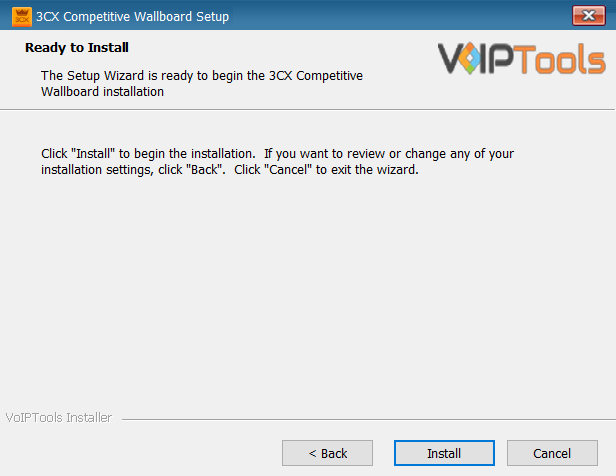
The application installation progresses. This may take several minutes to complete.
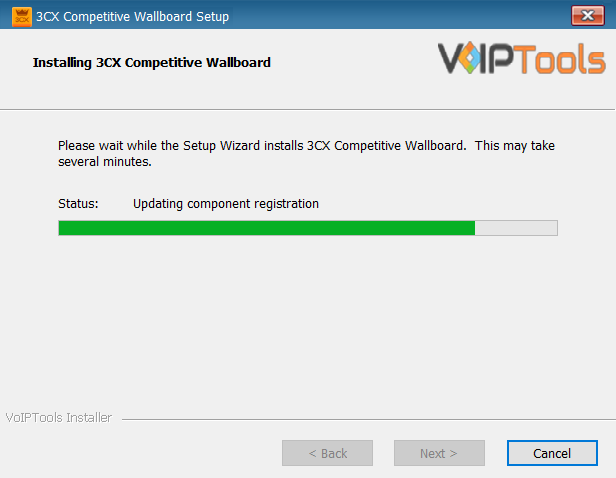
-
- Once the installation is complete, click Finish.
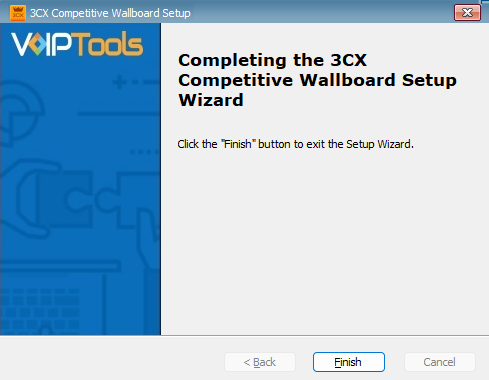
Step 7: Log in to the Web Application #
Follow the procedure to log in to the web application
- Double-click the 3CX Competitive Wallboard
 desktop icon to open the web application.
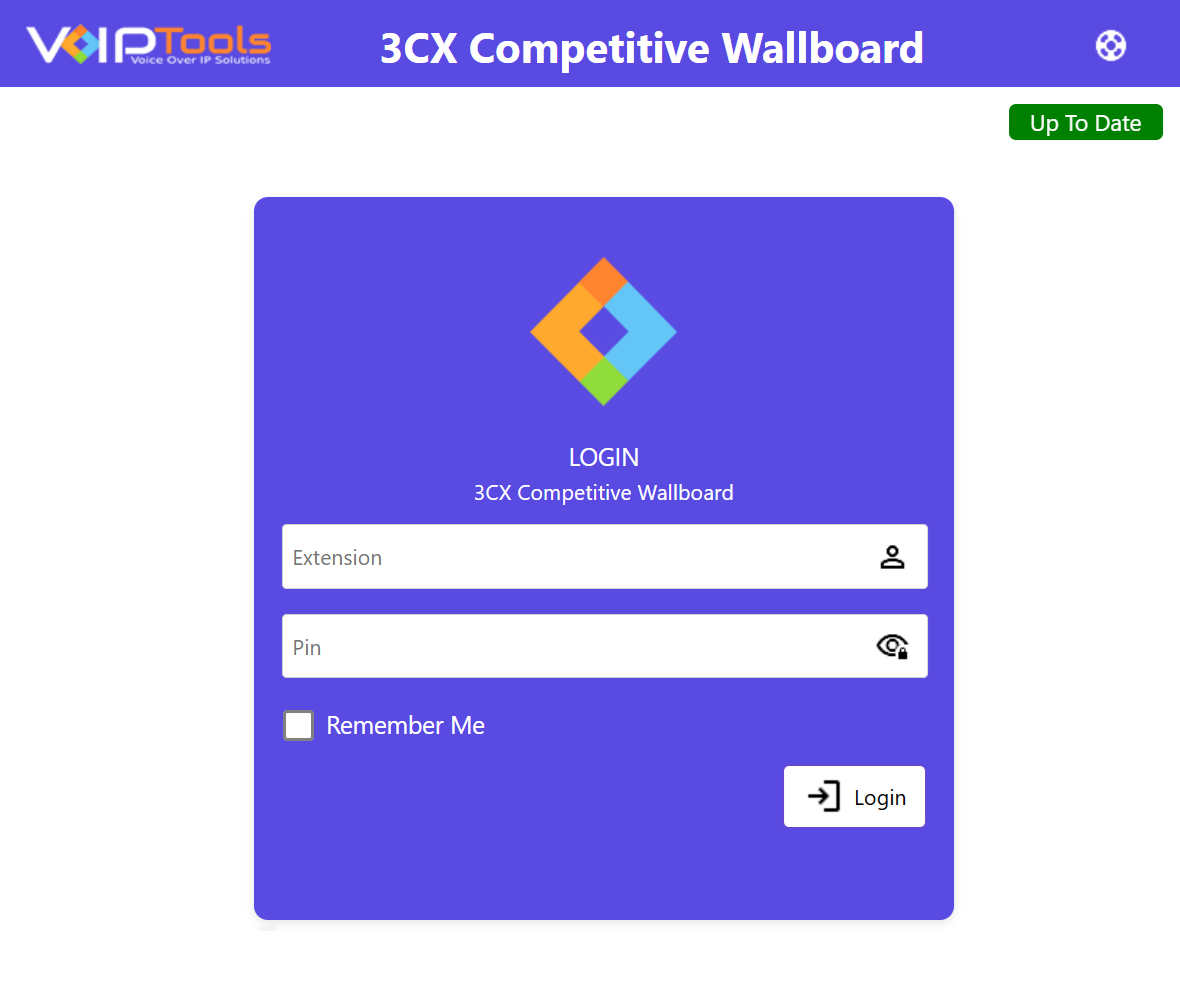
 - On the Login page, do the following tasks:
- In the Extension field, enter your 3CX extension number.
- In the PIN field, enter your 3CX voicemail PIN.
- Click the Login button to log in to your account.
Step 7: Log in to the Web Application #
Follow the procedure to log in to the web application
- Double-click the 3CX Competitive Wallboard desktop icon to open the web application.
- On the Login page, do the following tasks,
- In the Extension field, enter your 3CX extension number.
- In the PIN field, enter your 3CX voicemail PIN.
- Click the Login button to log in to your account.
When you first install the Wallboard, all users are treated as a “managers”. This gives you access to the settings pages where you configure the Wallboard extension group. The name of the 3CX extension group can be anything you choose, and managers of this extension group then become managers of the wallboard.
Once the extension group is created in 3CX and configured in the Wallboard, then you must be a member of this extension group to access the wallboard, and you must be a manager of this extension group to make changes to the wallboard configuration.
-
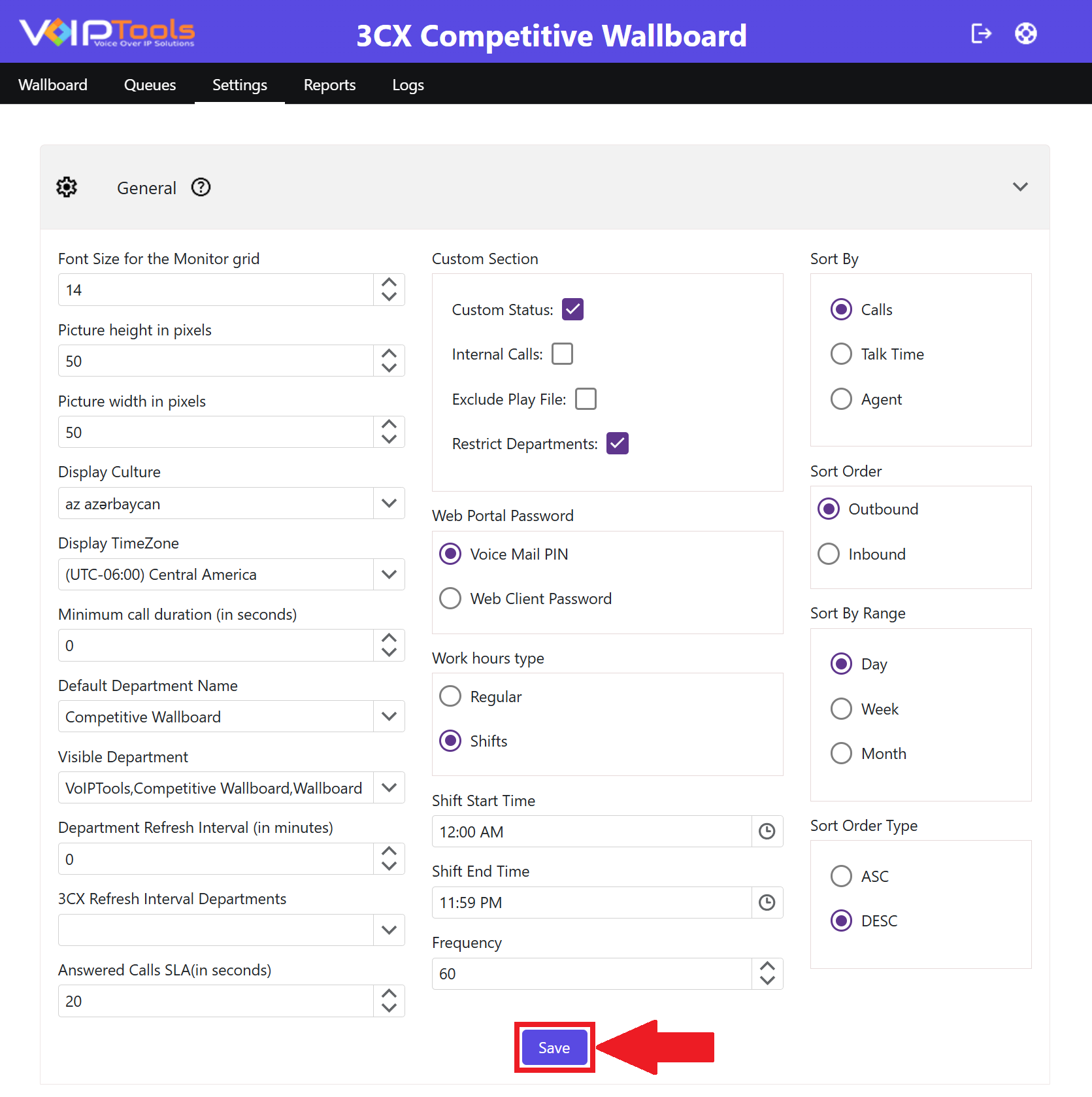
- In the Settings section and from the Default Departmet Name dropdown list, select the desired extension group name you want to set as the default one. Click here to learn how to create a new extension group in 3CX.
You cannot view the _DEFAULT_ and Favorite groups created in 3CX Competitive Wallboard.
In VoIPTools applications, the _Default_ Group has been intentionally excluded from the group selection list. In 3CX, the Default Group includes all members of the system. While this works fine for smaller environments, importing all members from the Default Group in larger systems can lead to performance issues
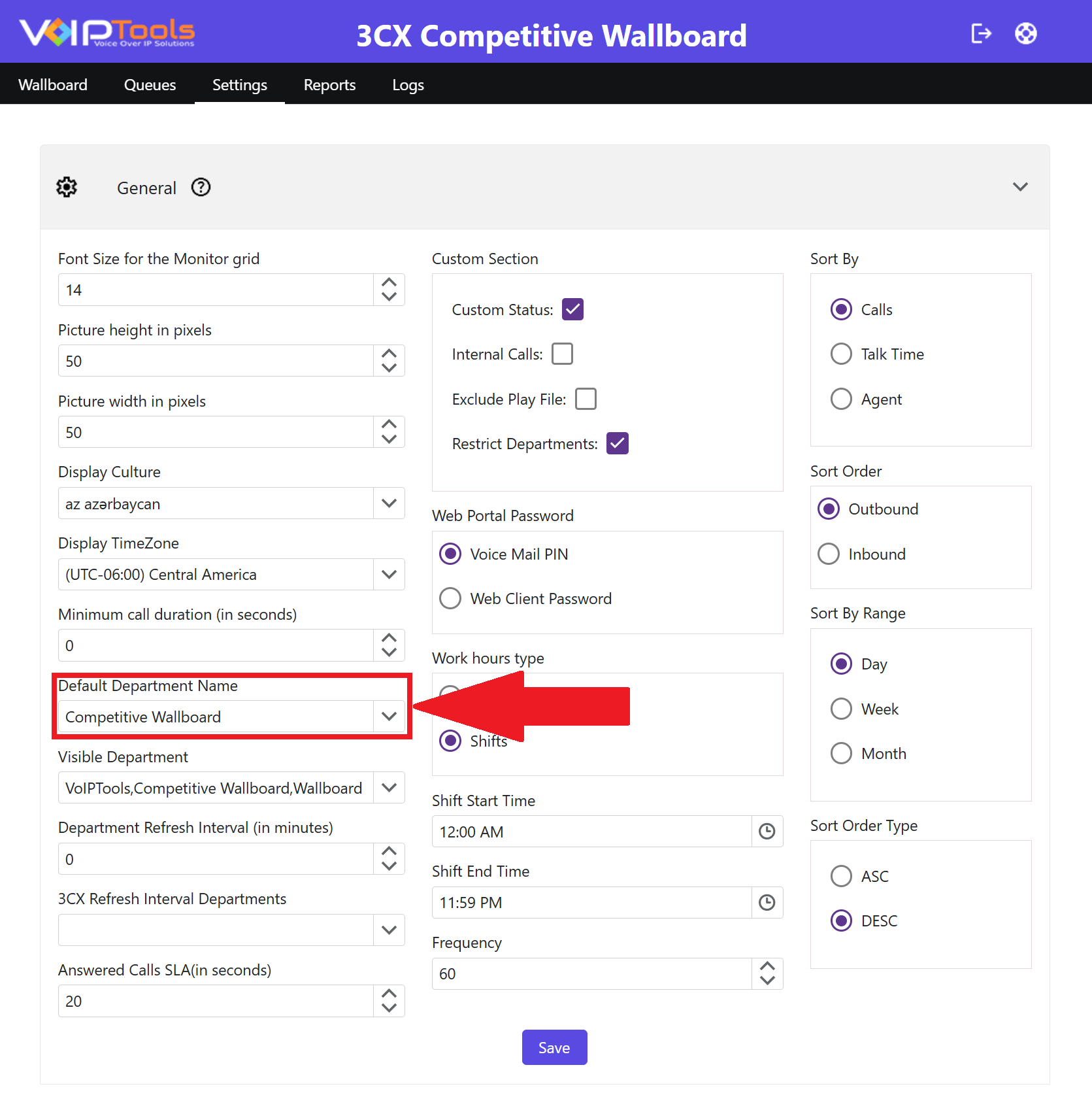
You can view all the tabs if you are either a manager of any groups in the 3CX Console Management or have admin rights to the 3CX Console Management.
-
- At the footer of the page, click Save.
Web Portal #
To access the 3CX Competitive Wallboard web portal, click the Web Portal button on the configuration program, or click on the desktop icon that was created during the installation process (3CX Competitive Wallboard Web).
Login Rights #
3CX Competitive Wallboard lets users log in as Agents and as Managers. Separate logins for agents and managers serve to control access, bolster security, customize experiences, enforce accountability, and streamline usability. This approach restricts unauthorized access, safeguarding sensitive functions. Managers, who often require more advanced privileges, can access tailored tools and settings
Manager Rights #
As a manager, you can perform the following activities in the Wallboard application:
-
- A manager can view and access data in all the menu options available in the Competitive Wallboard web portal.

As a manager, you can perform the following tasks,
-
- Activate/ Inactivate an agent.
-
- Add a new agent.
-
- Send a group message to your agents.
-
- Change the name of the existing agents.
-
- Upload new pictures or edit pictures of your agents.
-
- View an agent’s idle time during the shift hours of the day and since the latest call.
-
- View the current status of an agent and the time since the current status has been changed. View and export the complete status of your agents.
-
- View agent’s custom statuses.
-
- Set inbound and outbound day, week and month call quotas for any agent.
-
- Configure font size for the ‘Wallboard’ screen.
-
- Specify the 3CX Extension Group to monitor.
-
- Edit extension group.
-
- Set ‘Minimum Call Duration’ (in seconds) for an extension group so that a call can stand eligible for call count only after it reaches the set time.
-
- Set ‘Work hours type’ for an extension so that the calls made in the set working hours will stand eligible for call count.
-
- Set the ‘Sort Order’ setting for ‘Inbound’ or ‘Outbound’ calls in the ‘Wallboard’ screen to display the agents in descending order based on their inbound or outbound call count.
-
- Reorganize the order of columns in the wallboard screen except that the ‘Picture’ column is always the first one.
-
- Hide one or more columns in the wallboard screen except ‘Picture’ column.
-
- View and export call log reports in various formats.
-
- Customize the color, logo, and other elements to establish your brand identity.
Agent Rights #
As an ‘Agent’, you have the following rights:
-
- Agents can view only Wallboard and About screens.
-
- An agent cannot edit any data.

#
Settings Menu #
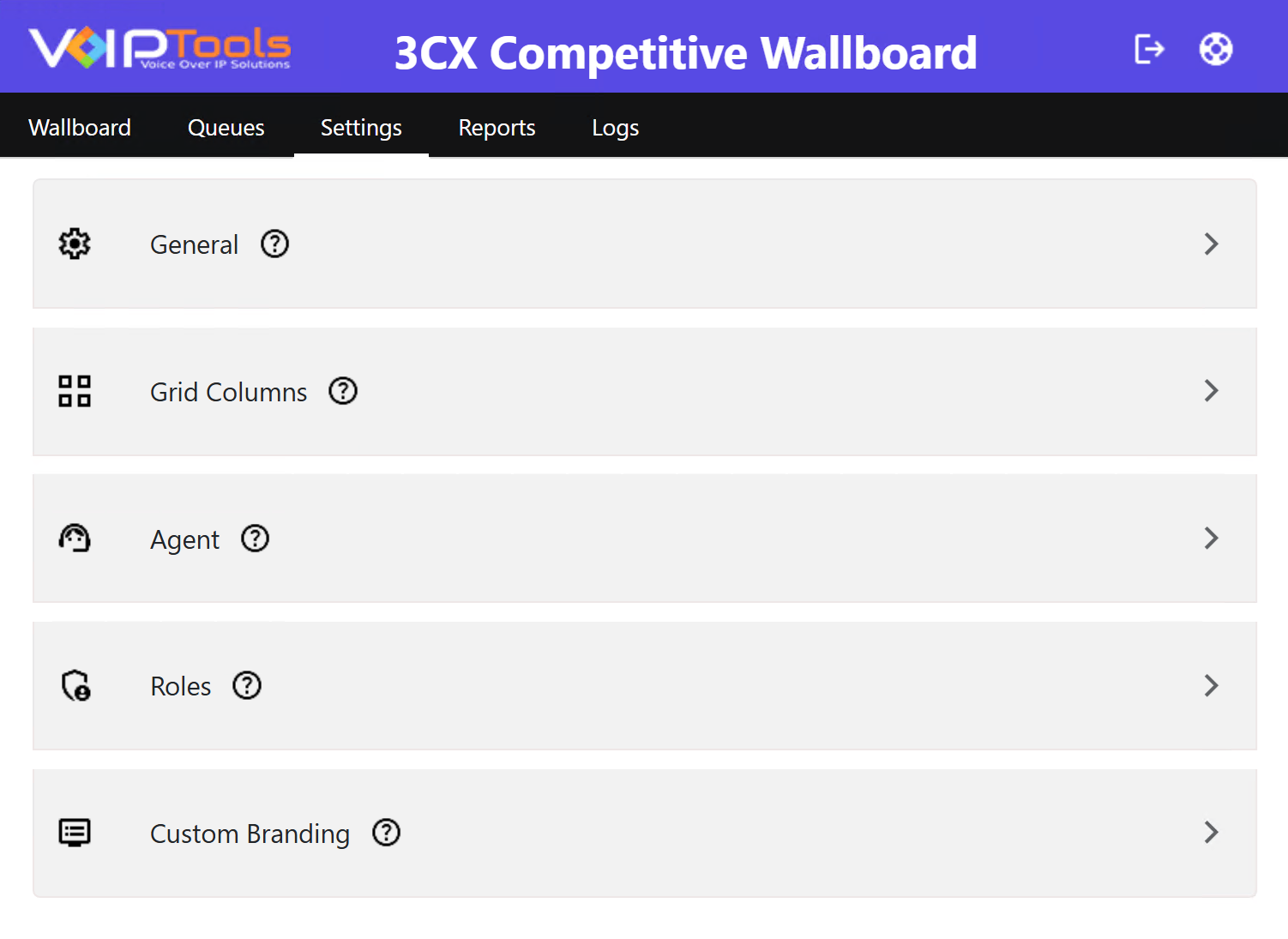
The Settings menu is where you shape how the Competitive Wallboard looks and works. It brings together the main setup areas in one place, so you can quickly adjust general behavior, column layout, agent details, user roles, and branding without hunting through the app.
This menu includes:
-
General for core wallboard options.
-
Grid Columns for choosing which data appears and how it is ordered.
-
Agent for agent-related settings.
-
Roles for access and permission control.
-
Custom Branding for applying your own visual identity.
It is designed to give managers and administrators a single, easy starting point for configuring the wallboard to match their team’s needs.
#
#
General settings #
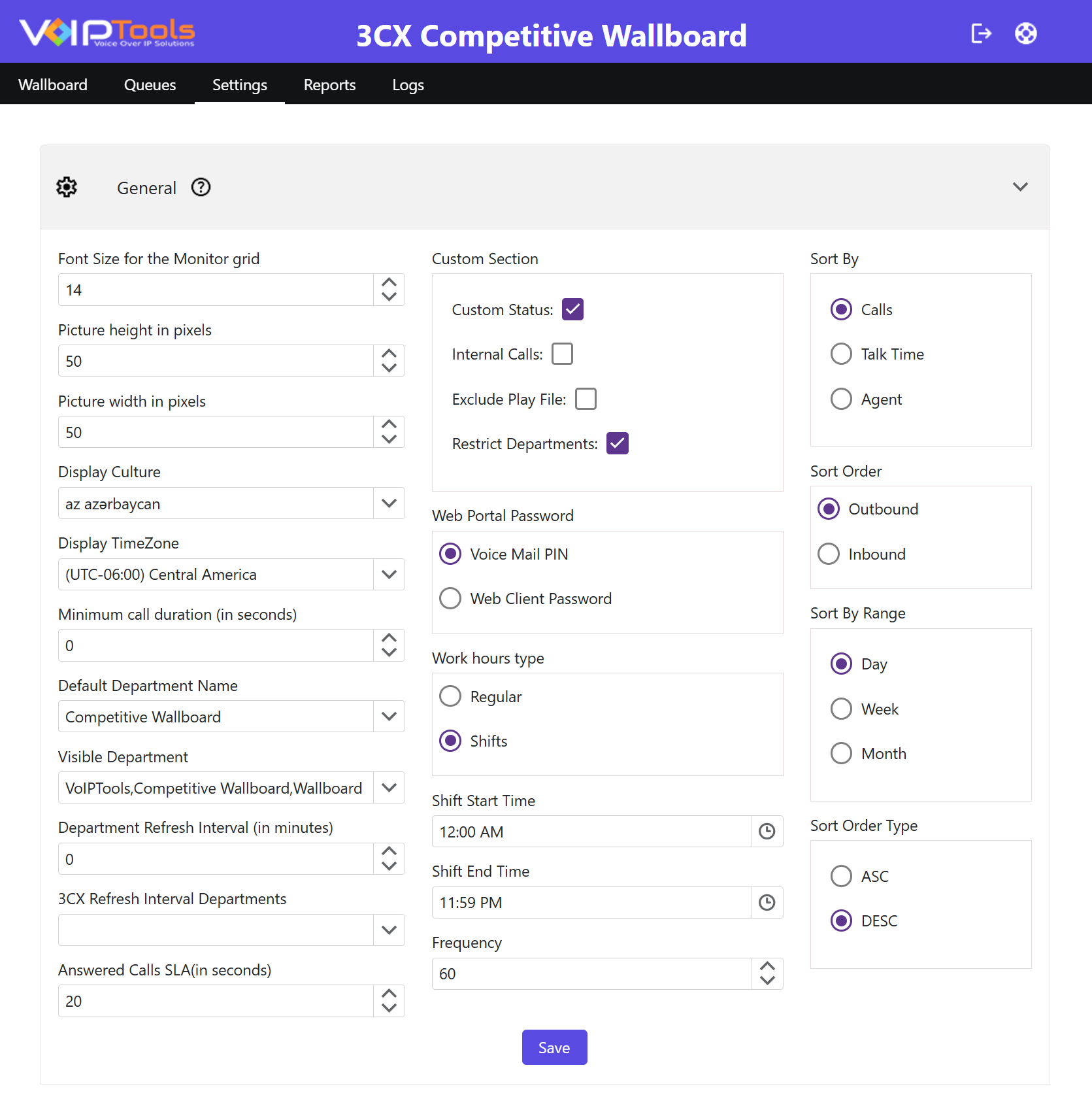
In the General panel, you shape how the Wallboard looks and which calls count toward your stats. The panel groups its settings into three parts: display and department options on the left, status and schedule options in the middle, and sort order on the right.
Edit font size #
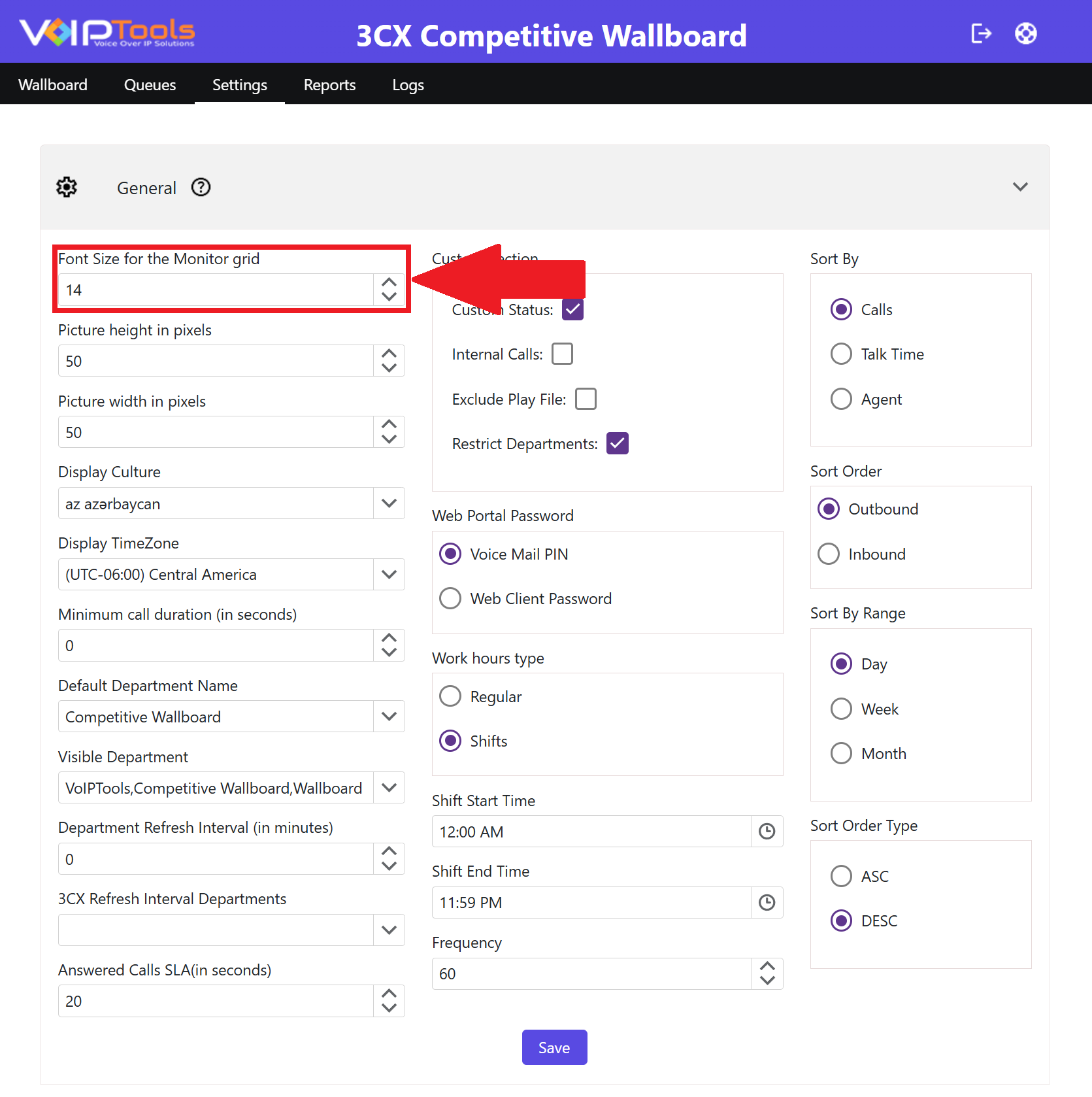
Adjust Font Size for the Monitor grid so Wallboard text is easy to read from wherever your team sits. Type a value, then click Save.
Edit picture height and width #
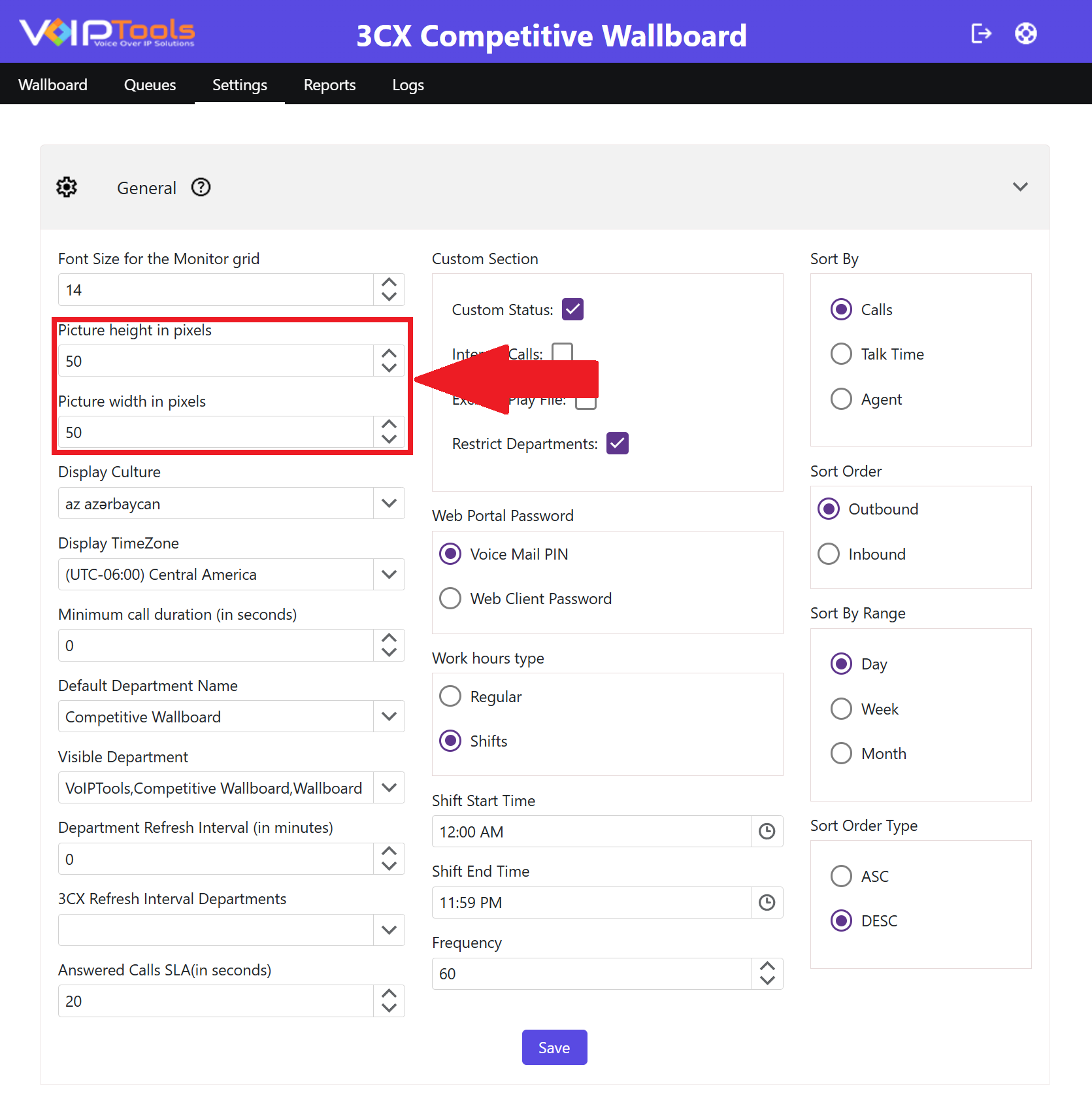
Type pixel values in Picture height in pixels and Picture width in pixels, then click Save.
Set display culture #
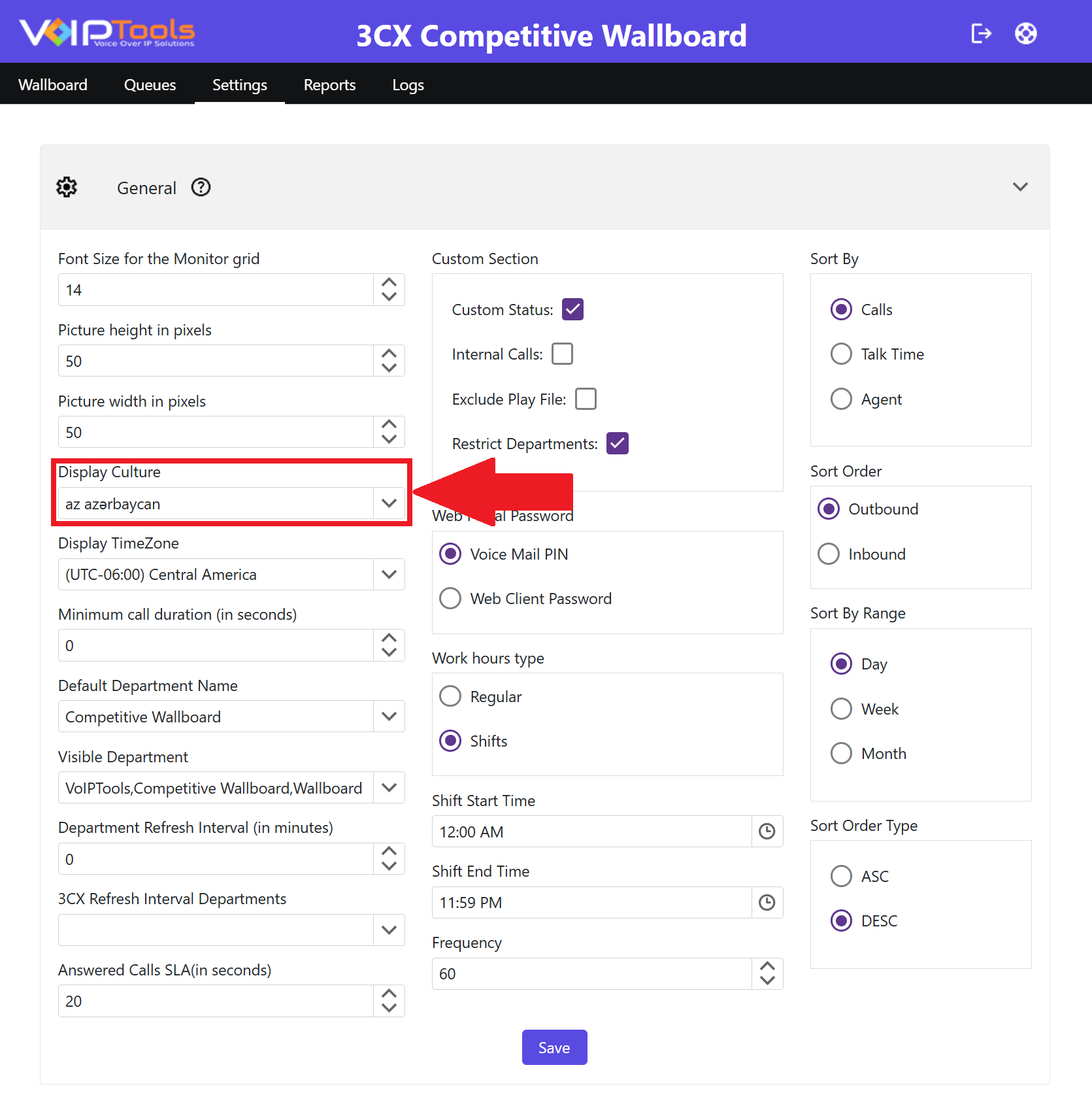
Pick a language and region from Display Culture, then click Save. This sets dates, times, and other local formats across the Wallboard, and it also sets the transcription language.
Set Display TimeZone #
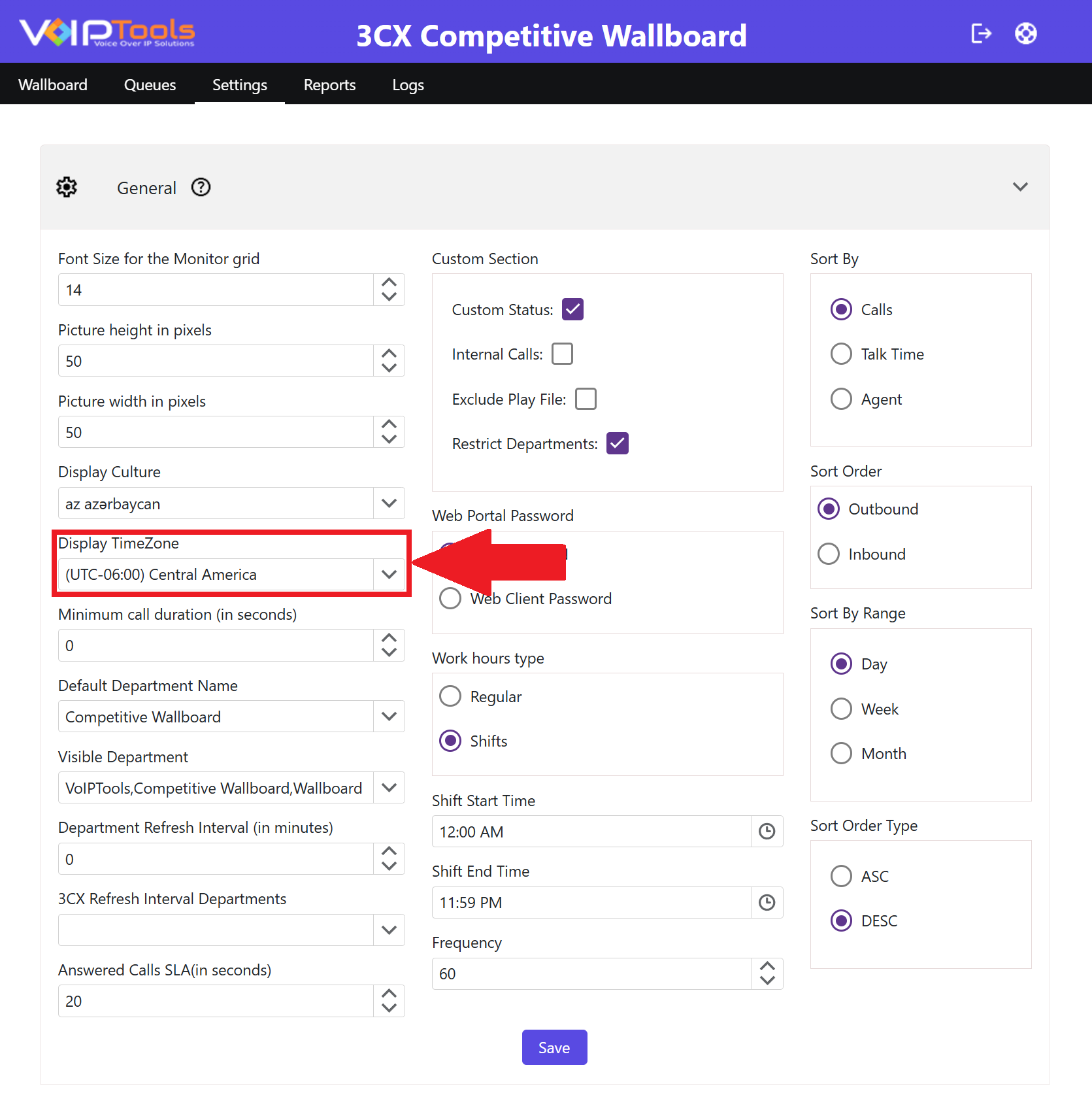
Pick your time zone from Display TimeZone, then click Save. Every time stamp, call length, and report on your Wallboard uses this zone.
Set minimum call duration #
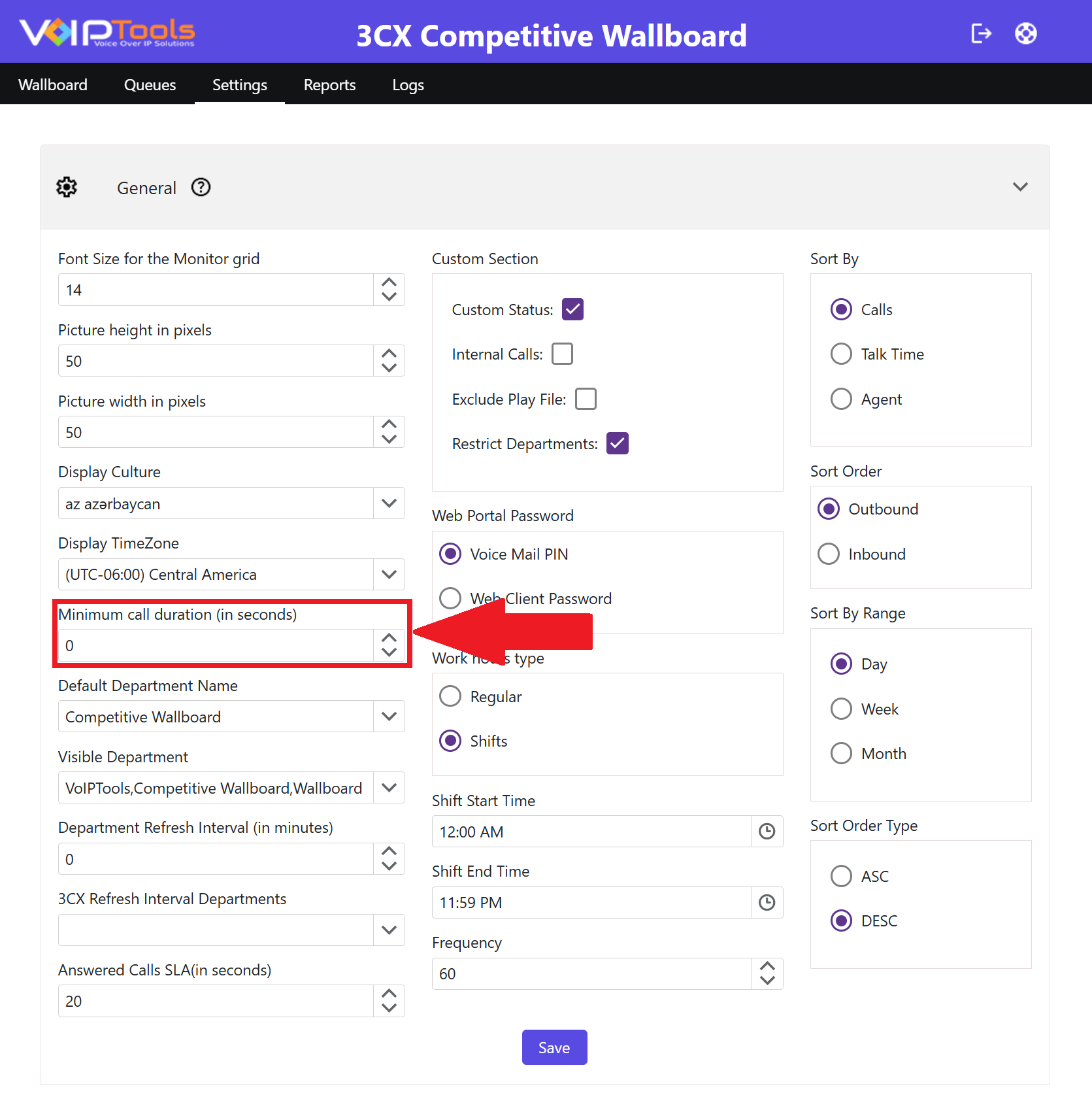
Use Minimum call duration to keep quick hang ups out of your call counts. Type the number of seconds, then click Save.
Choose default and visible departments #
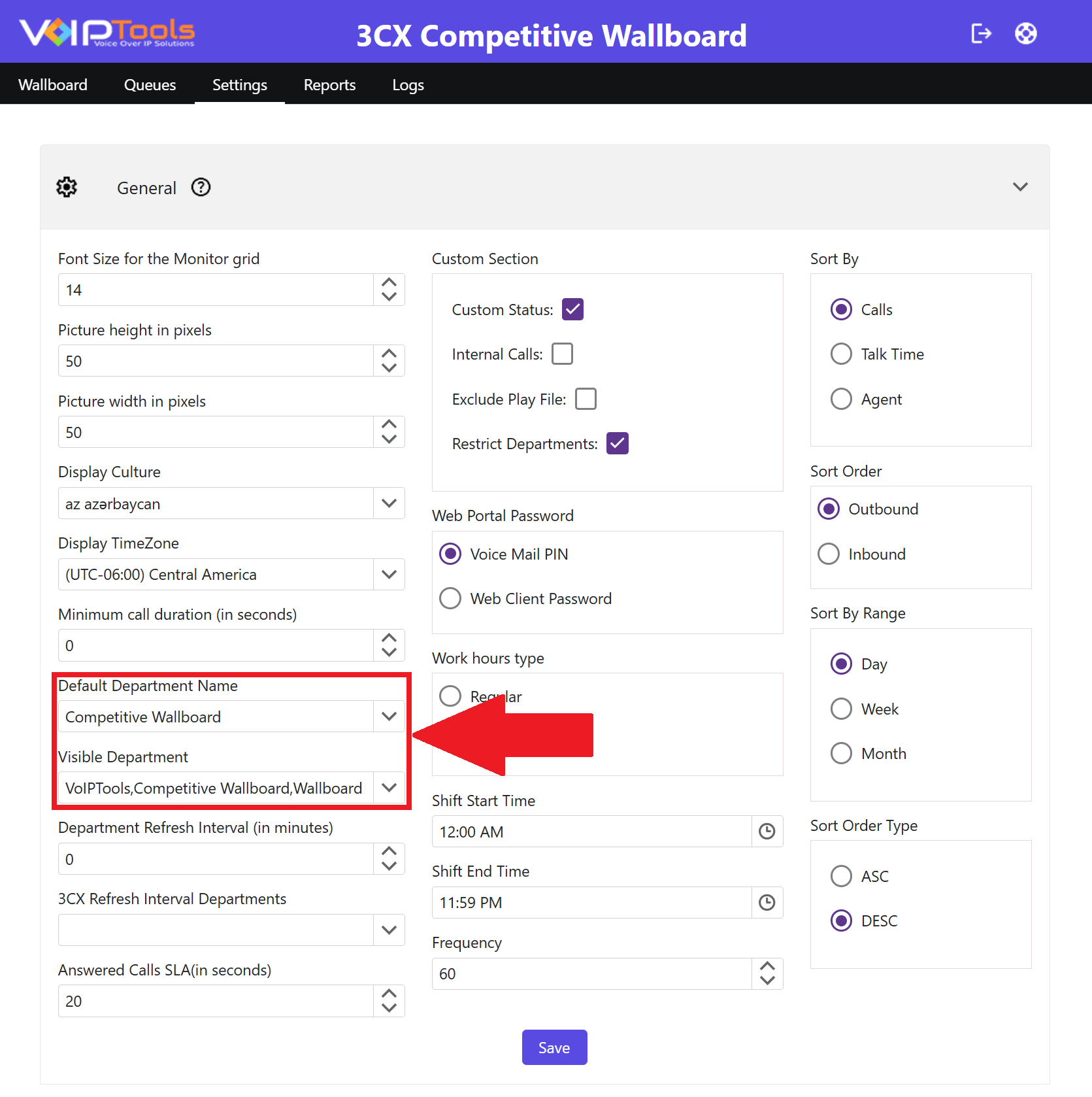
Pick the department that loads first from Default Department Name. Then pick every department to show in the Wallboard’s department list from Visible Department. Click Save.
Cycle through departments on a timer #
Want the Wallboard to rotate through more than one department on its own? Type how many minutes each department should show in Department Refresh Interval (in minutes). Then pick which departments to include in the cycle from 3CX Refresh Interval Departments. Click Save.
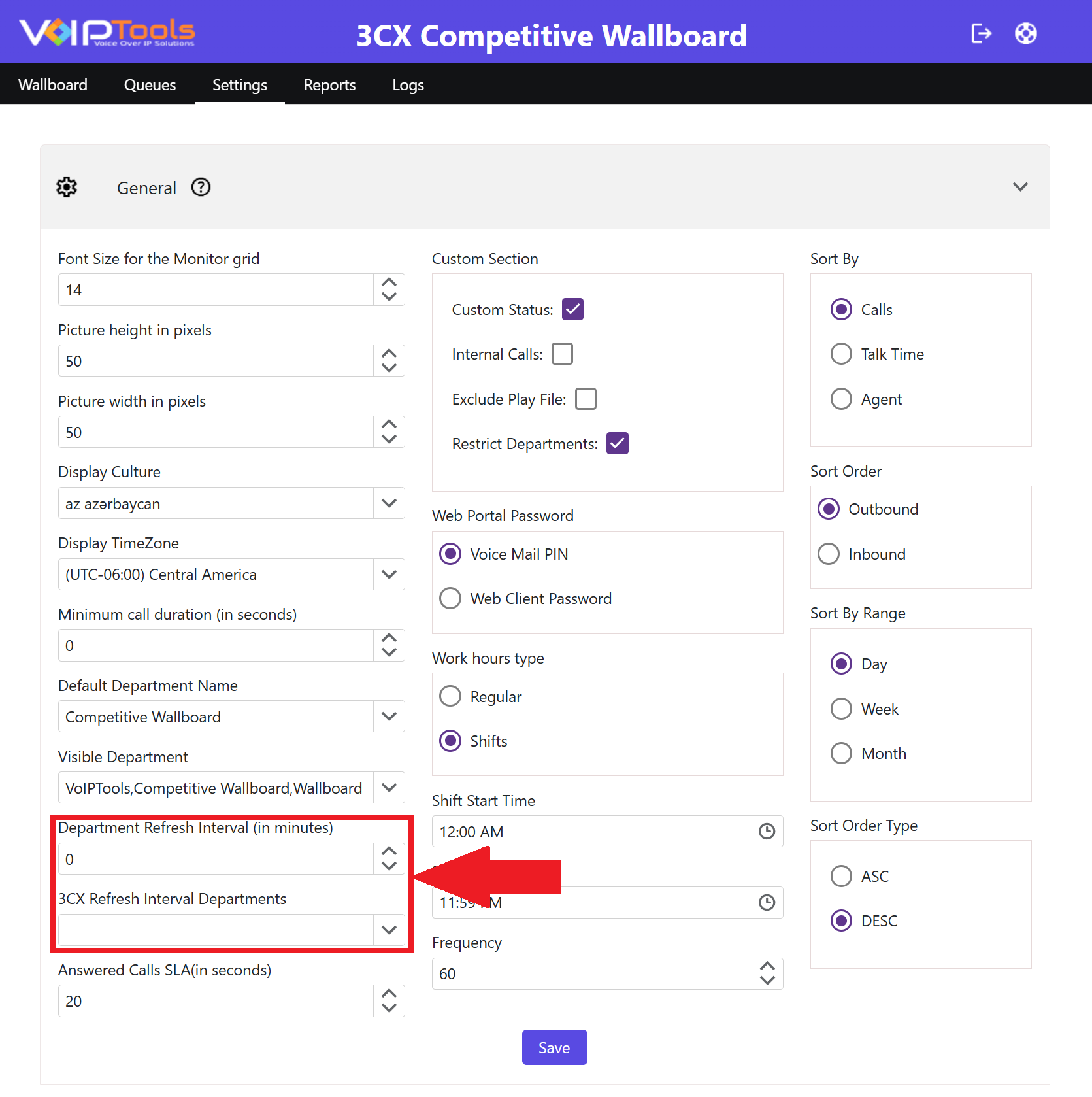
If someone picks a department that is not part of this cycle, the cycle stops and the Wallboard shows just that department. Pick a department that is part of the cycle to start it again.
Set Answered Calls SLA #
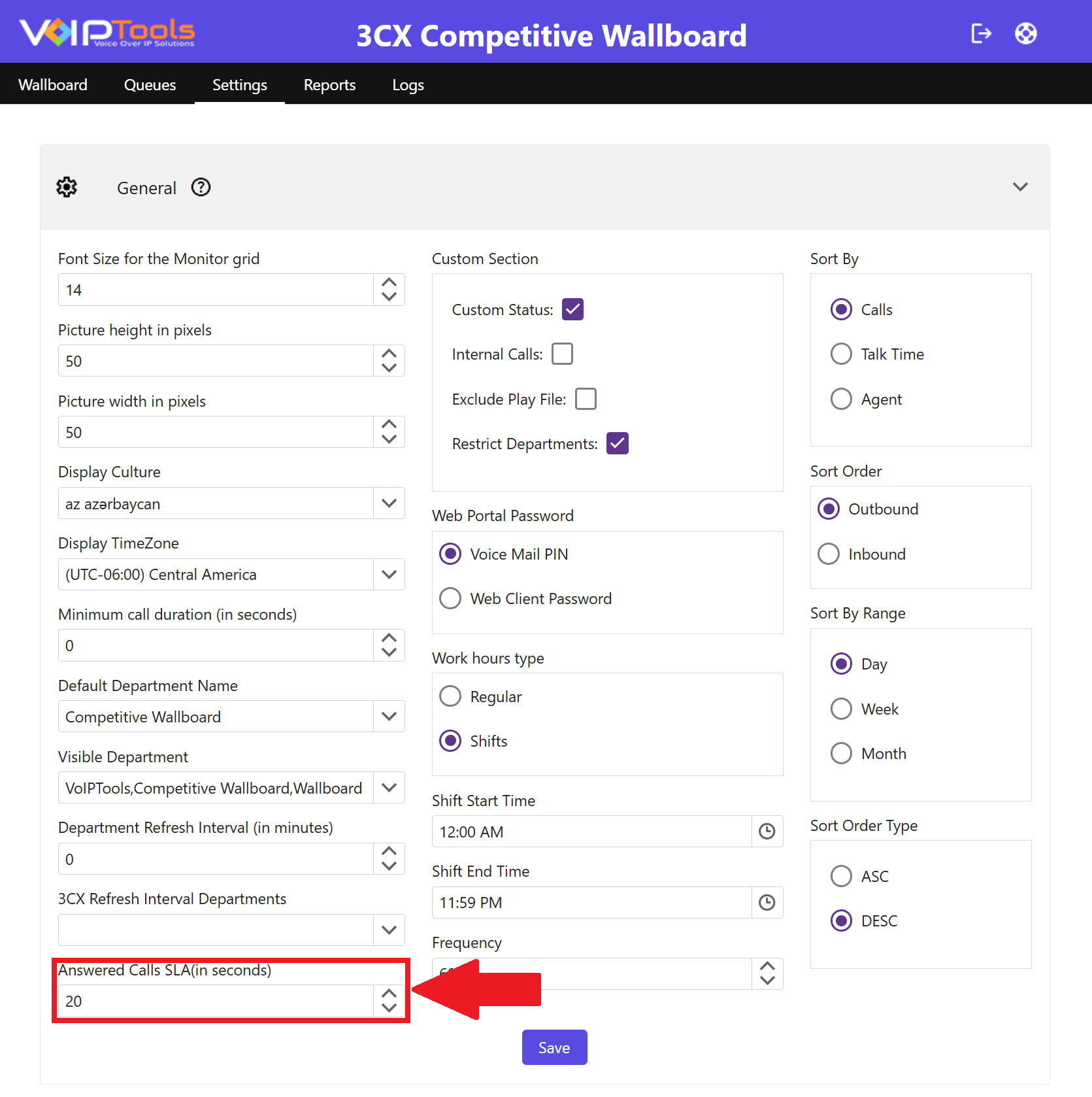
Set Answered Calls SLA to define what counts as answered on time for your team. Type your target answer time, in seconds, then click Save.
SLA percent = (calls answered within your target ÷ total calls) × 100
Set Custom Section options #
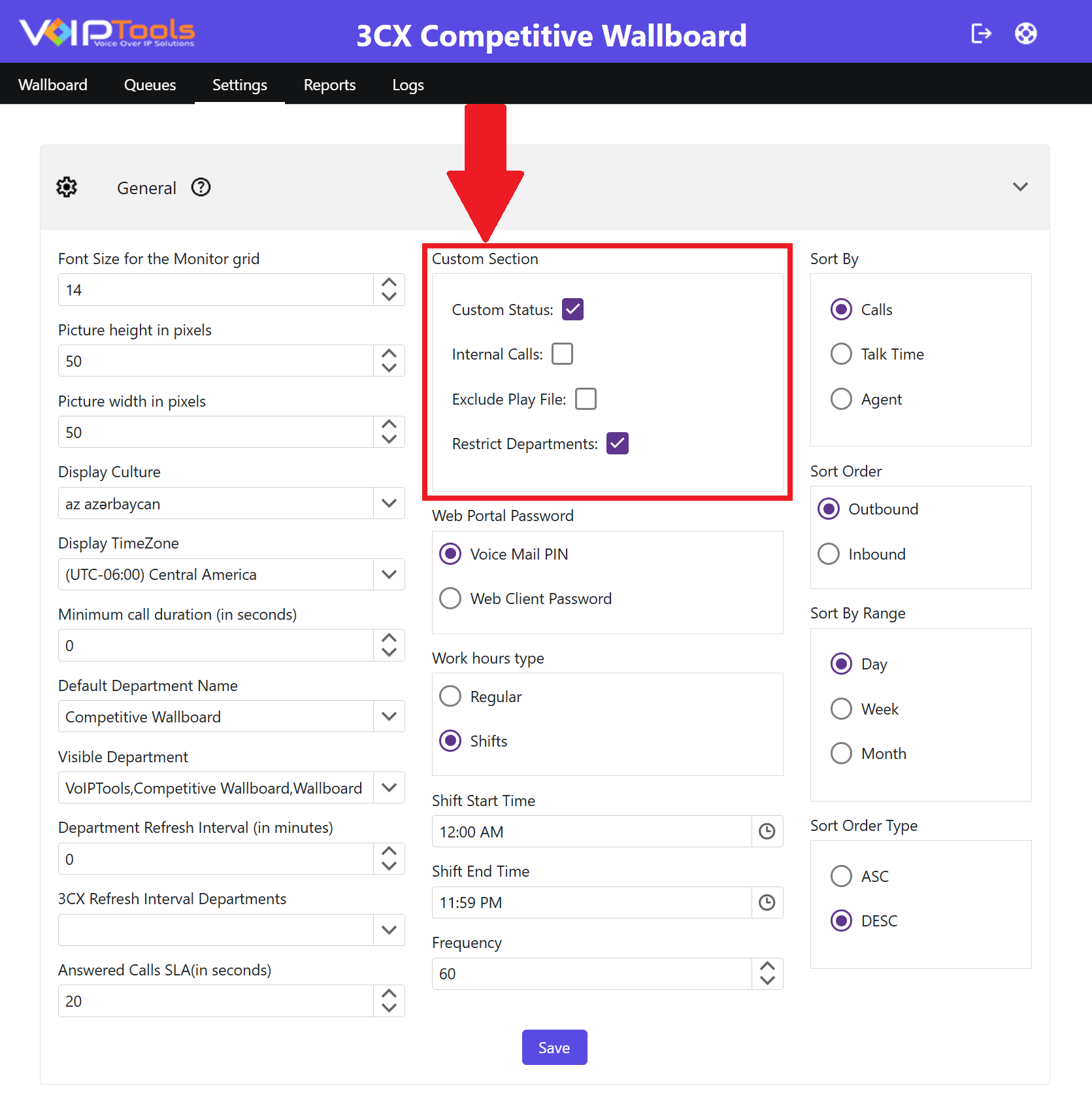
The Custom Section box contains four checkboxes that turn Wallboard features on when selected and off when cleared then click Save.
| Checkbox | Shown here | What it does when checked |
|---|---|---|
| Custom Status | Checked | Shows each agent’s custom status, pulled from the 3CX Custom Presence app, on the Wallboard. |
| Internal Calls | Clear | Counts calls between extensions in your Wallboard totals. |
| Exclude Play File | Clear | Leaves play file stats out of call details and reports. A play file is a recorded prompt used in your call flow, like a greeting or hold message. |
| Restrict Departments | Checked | Limits visibility to the departments set in Visible Department. |
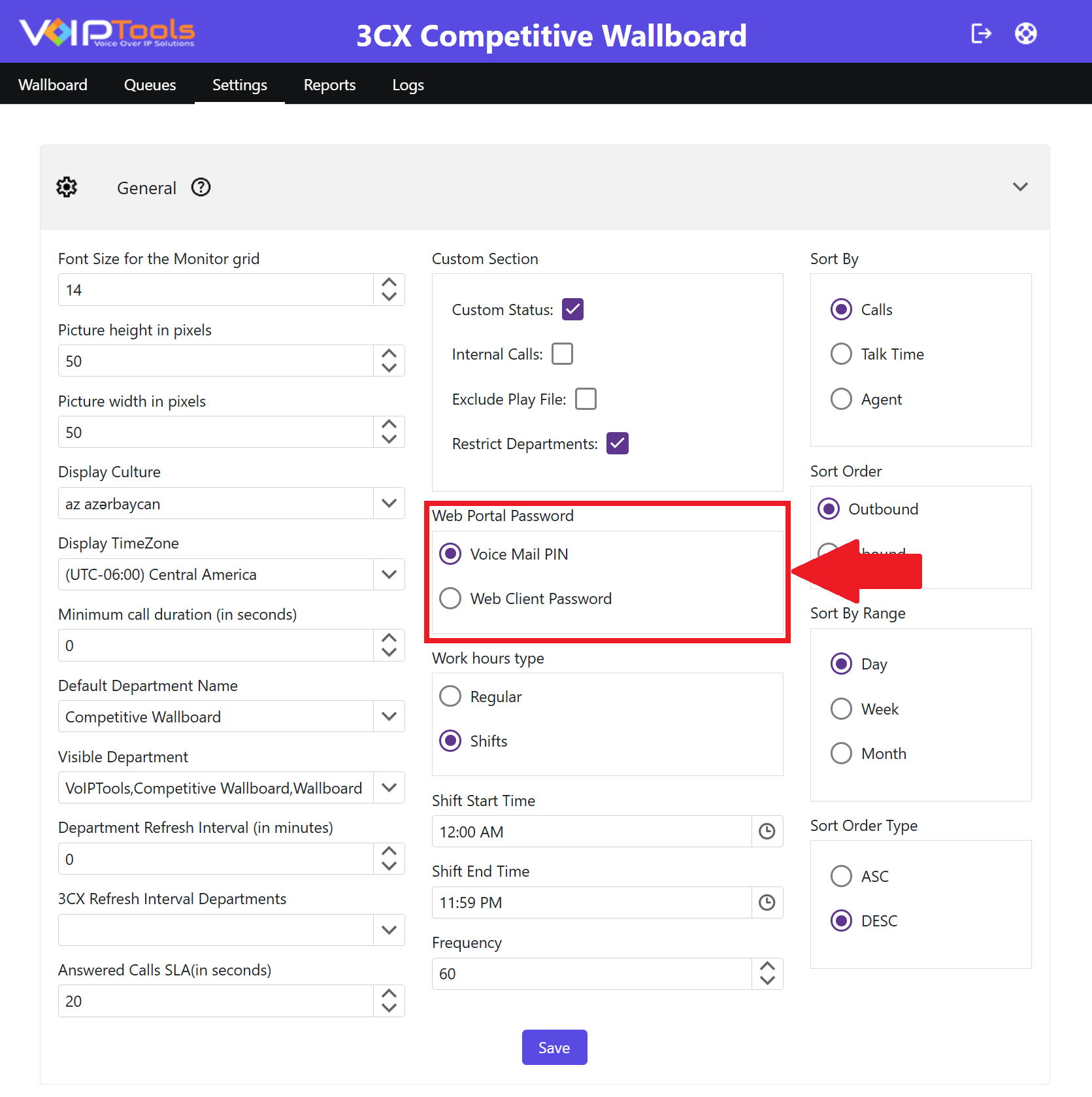
Choose your Web Portal Password #
Pick which credential agents use to sign in to the web portal.
| Option | When to use it |
|---|---|
| Voice Mail PIN | Uses each agent’s voicemail PIN as the password. Good if your team already uses this credential. |
| Web Client Password | Uses the 3CX Web Client password instead. Choose this if your organization keeps web client credentials apart from voicemail PINs. |
Pick an option, then click Save.
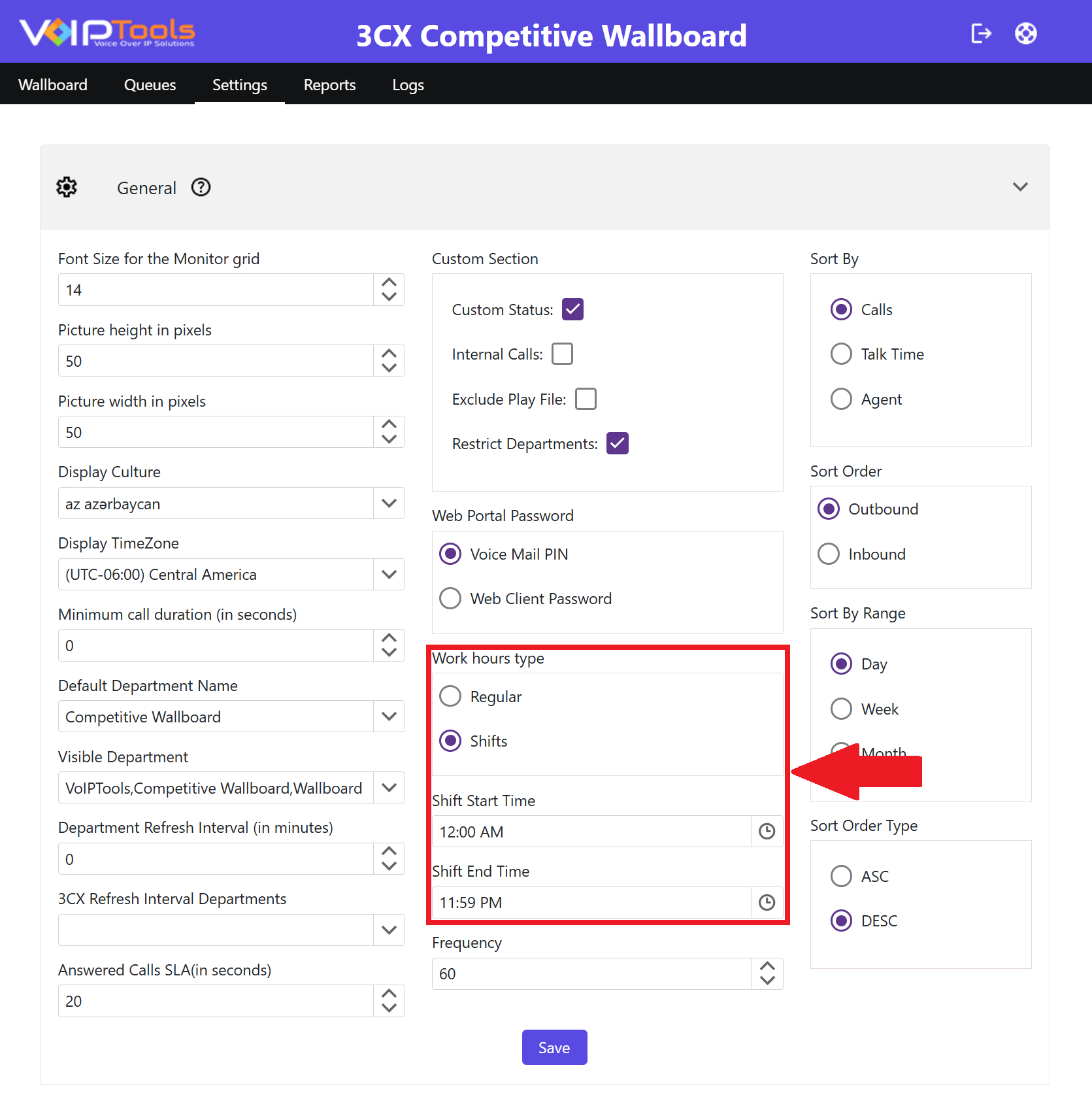
Set working hours #
Calls made outside these hours do not count toward agent totals.
-
Choose your schedule type.
Select Regular for the full day, or Shifts to set your own hours. -
Set your shift times.
If you choose Shifts, set the Shift Start Time and Shift End Time. -
Save your choice.
Click Save.
Regular covers the full day, 12:00 AM to 11:59 PM.
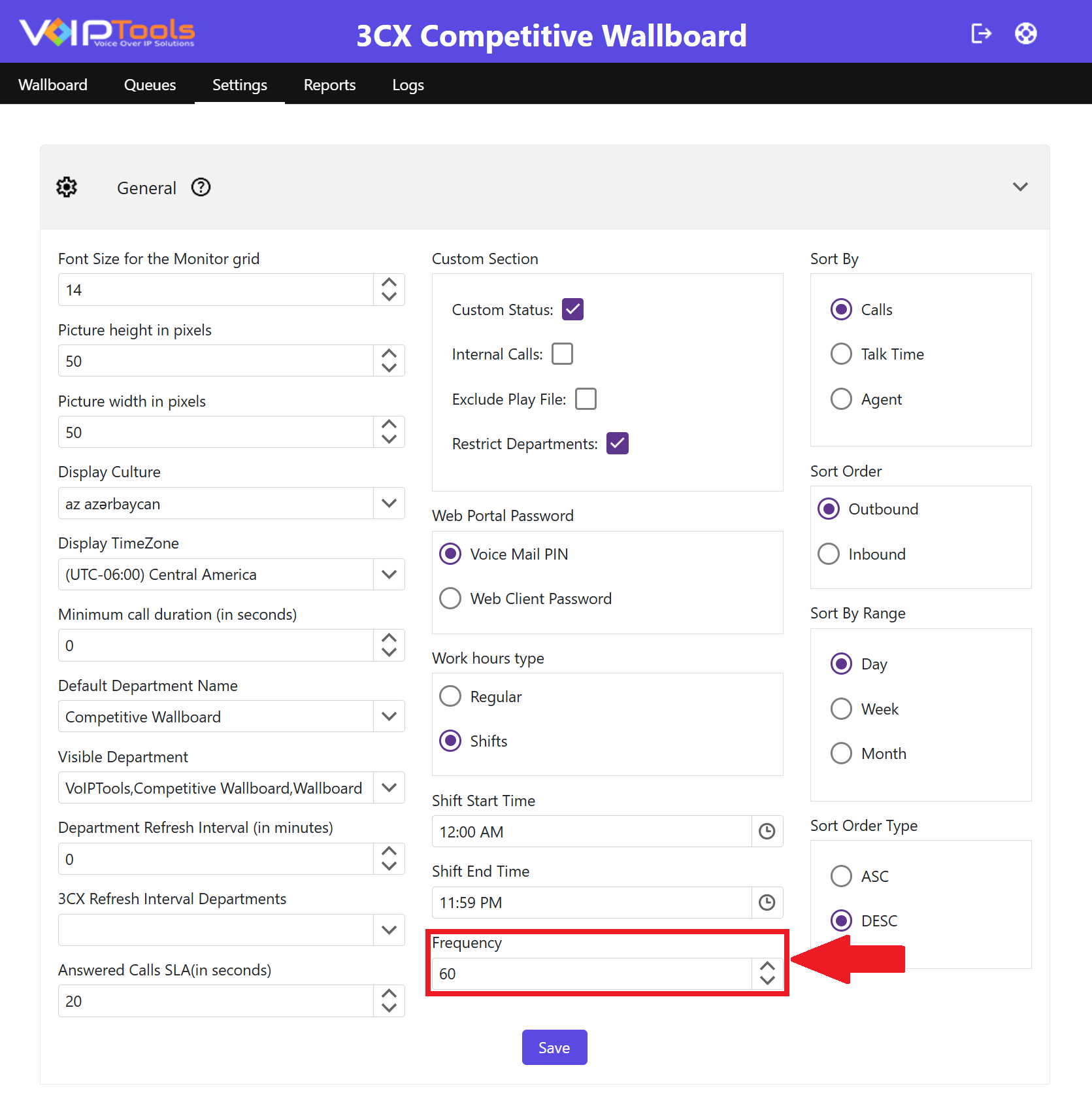
Set Frequency #
Type a value, in seconds, in Frequency to set how often the Wallboard grid refreshes. A short interval keeps data fresh but adds load. A longer interval eases that load but updates less often. Click Save.
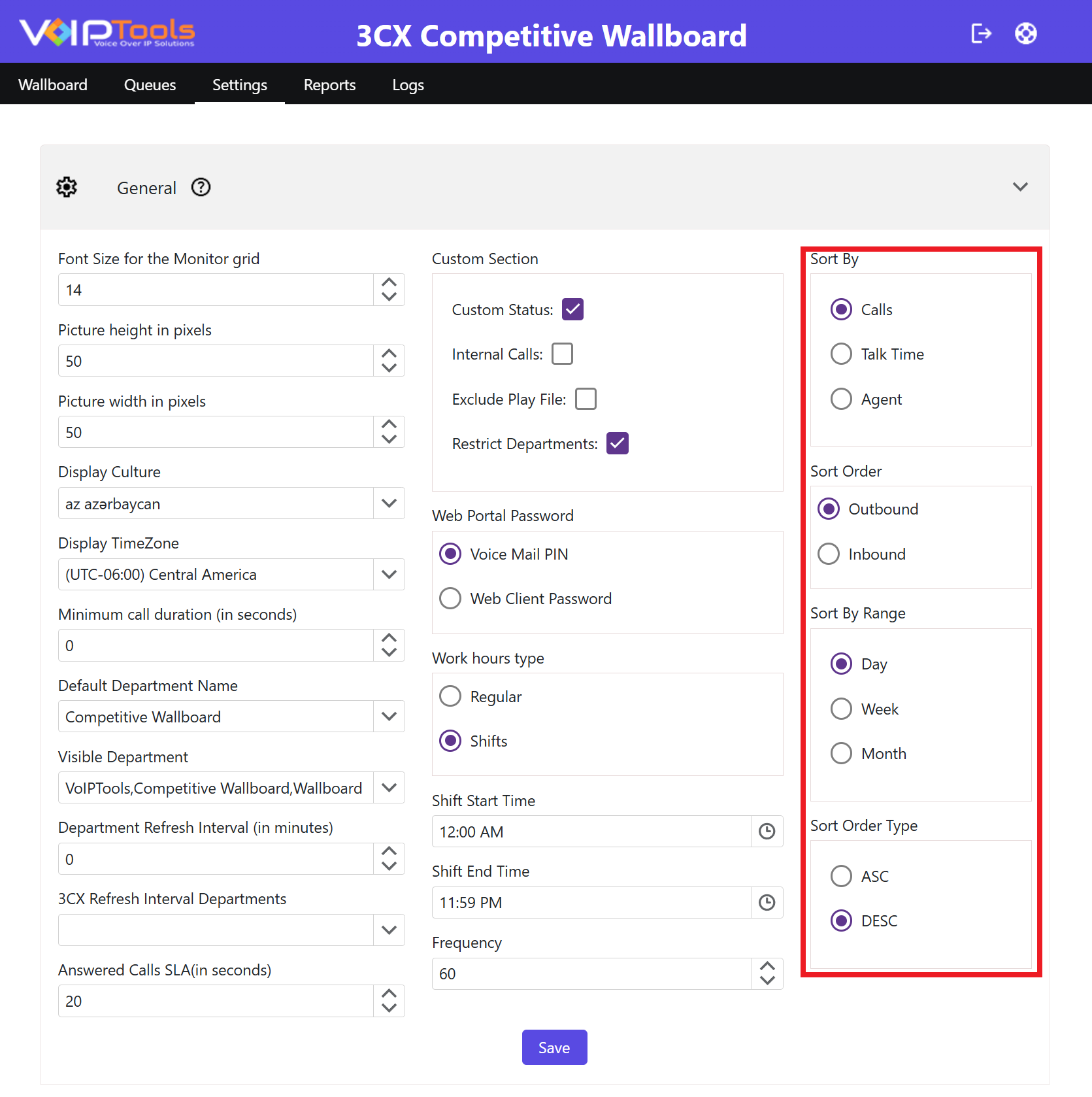
Sort Wallboard data #
These four settings determine how agents rank on the Wallboard. Together, they answer four questions:
- What are agents ranked by?
- In which direction are they ranked?
- Over what period are they ranked?
- Are the highest or lowest values ranked first?
Sort By: What are agents ranked by
| Option | Description |
|---|---|
| Calls | Ranks agents by total number of calls handled. The most common choice for competitive leaderboards. |
| Talk Time | Ranks agents by total time spent on calls. |
| Agent | Sorts agents by name. A neutral option when you don’t need a performance rank. |
Sort Order: Which direction are they ranked
| Option | Description |
|---|---|
| Outbound | Stats based on calls made by agents. |
| Inbound | Stats based on calls received by agents. |
Sort By Range: What period are they ranked
| Option | Description |
|---|---|
| Day | Shows today’s activity alone. Good for short contests. |
| Week | Current week’s activity. |
| Month | Current month’s activity. |
Sort Order Type: highest first or lowest first
| Option | Description |
|---|---|
| DESC | Highest performers appear at the top. This is the typical leaderboard format. |
| ASC | Lowest performers appear at the top. Good for spotting who may need support or coaching. |
Pick your options, then click Save.
The Save button, at the bottom of the panel, stores every change on this screen. Make one change or several, then click it once.
Grid Columns #
The Grid Columns tab controls which columns show on your Wallboard, and in what order. Pick the exact details your team needs to see, nothing more.
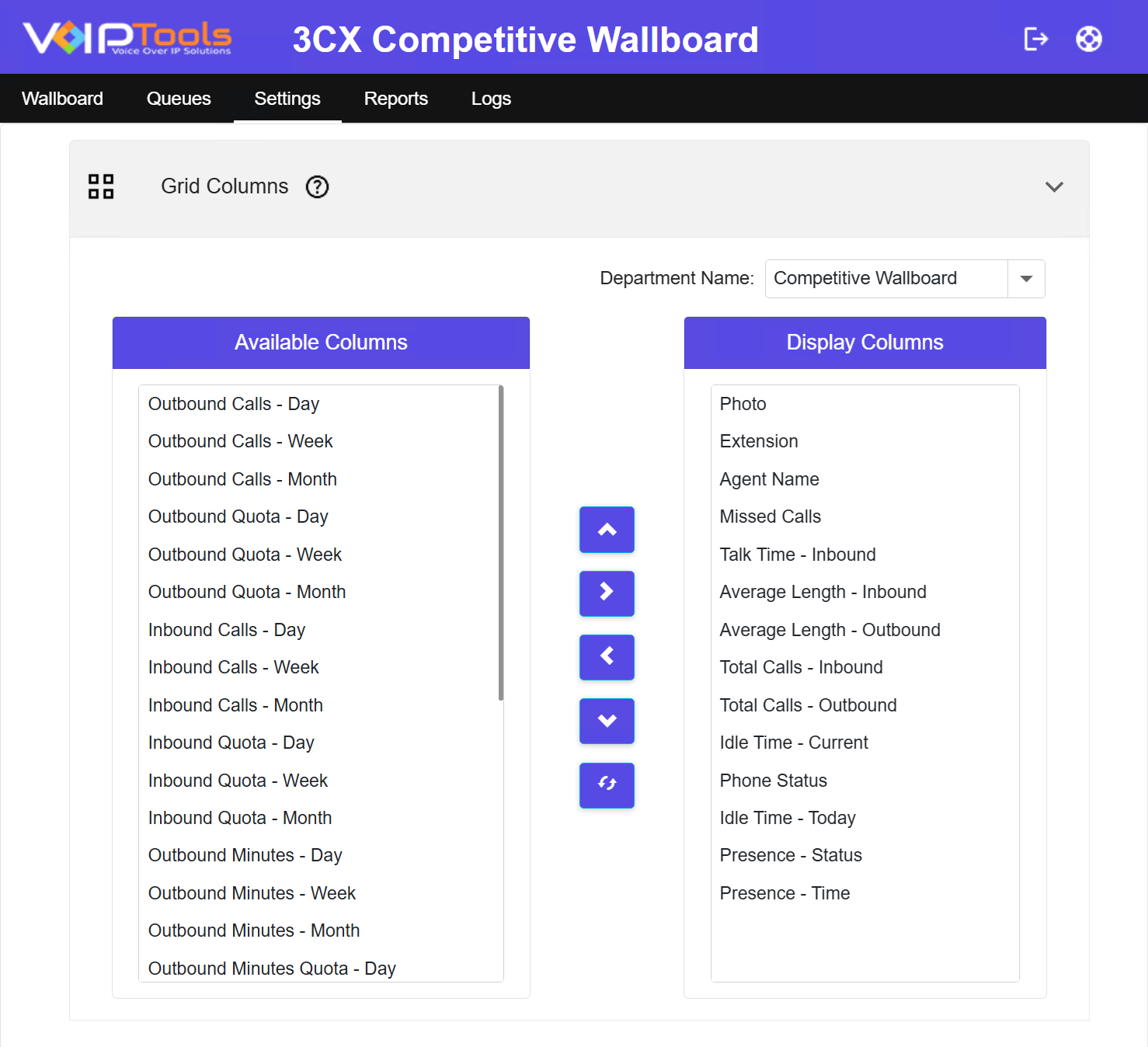
Customize your grid columns #
Hide a column #
- Select a column in Display Columns.
- Click Left
 to move it to Available Columns.
Show a column #
- Select a column in Available Columns.
- Click Right
 to move it to Display Columns.
Change the order #
- Select a column in Display Columns. You can select more than one.
- Click Up
 to move it higher, or Down
  to move it lower.
Reset to default #
Click Reset to put Display Columns back to the default set and order.
If you pick more than one time range for the same call type, keep those columns next to each other in Display Columns. For example, keep Outbound Calls – Day and Outbound Calls – Week together. Placing a different call type between them, like Inbound Calls – Day, can show the wrong details on your Wallboard.
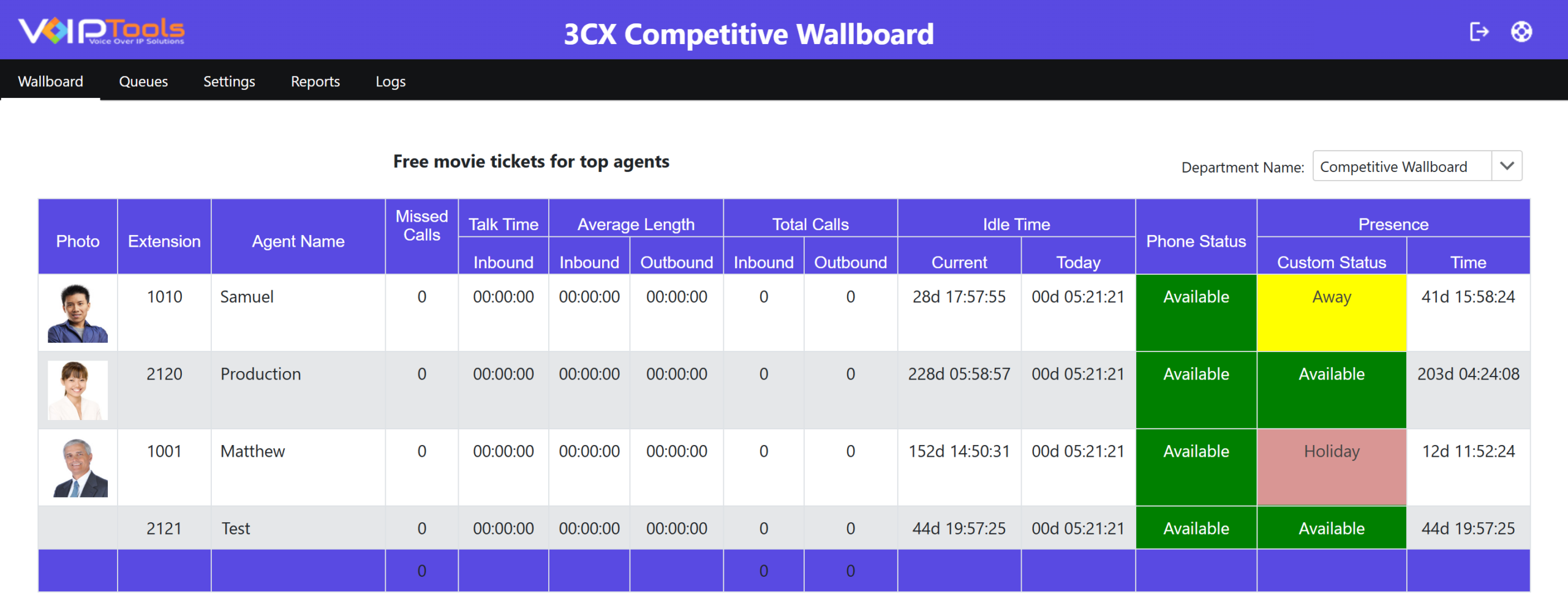
The following image shows the Wallboard tab for the columns configured above,
Pick a department to configure #
- Select a department from Department Name to load its column setup.
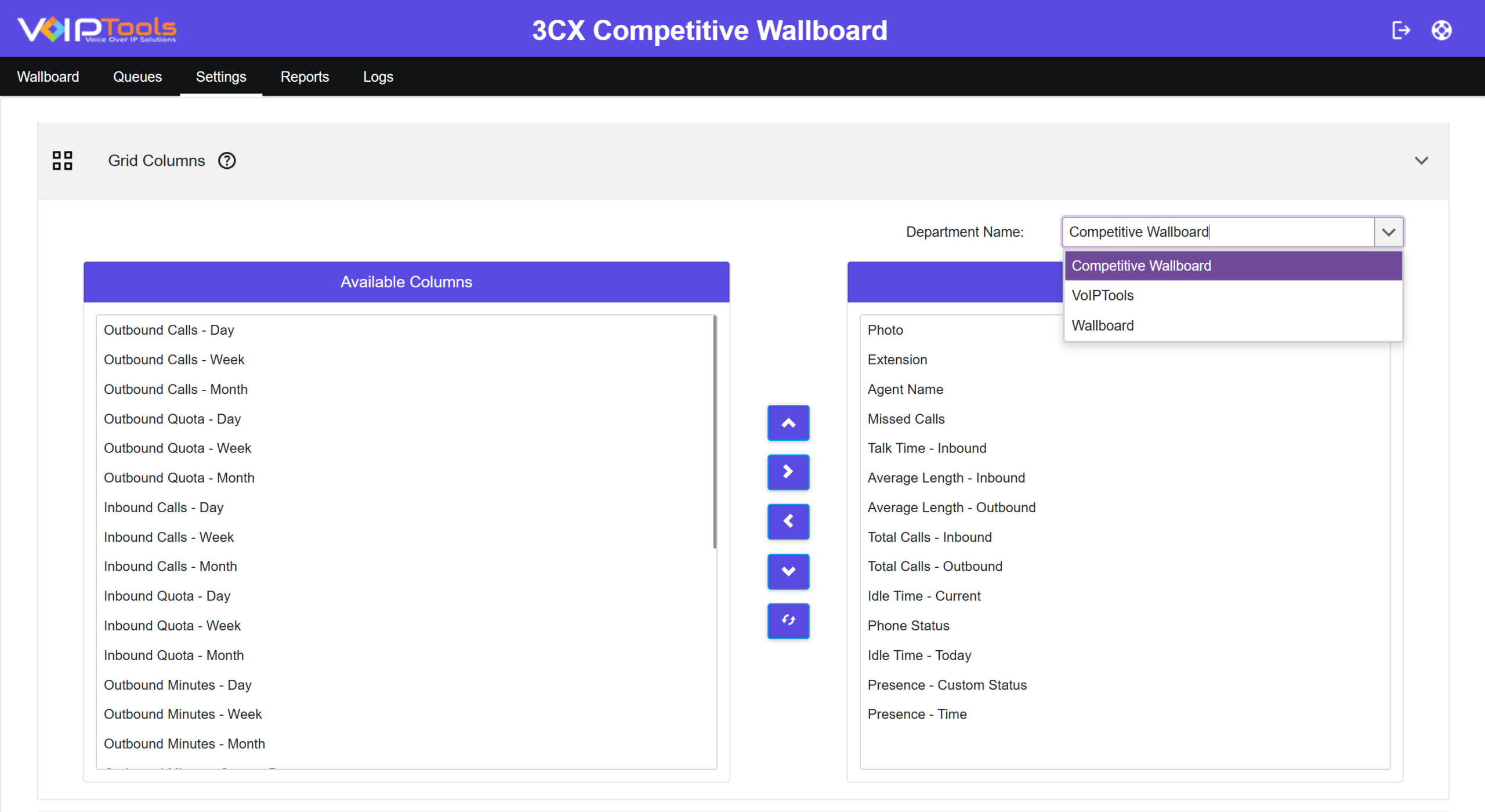
Figure 44: Department Name dropdown - Modify Available Columns or Display Columns as needed. Changes apply only to the selected department.
Grid Column Management: Roles and Department Level Controls #
In the Competitive Wallboard application, Managers and Admins control grid columns through Grid Columns settings. Here are three cases that show how a change affects different users.
Case 1: A Manager’s changes apply to their department #
When a Manager updates the grid columns, everyone in that Manager’s department sees the updated columns.
Case 2: A Manager cannot change another department’s columns #
A Manager can change grid columns for their own department alone. If a Manager belongs to a second department too, they can change that department’s columns as well.
Case 3: An Admin’s changes can span several departments #
When an Admin updates the grid columns, the change applies to every department the Admin belongs to. An Admin cannot change columns for a department they do not belong to.
Each department keeps control over its own settings. Admins can reach across several departments at once.
Agents Tab #
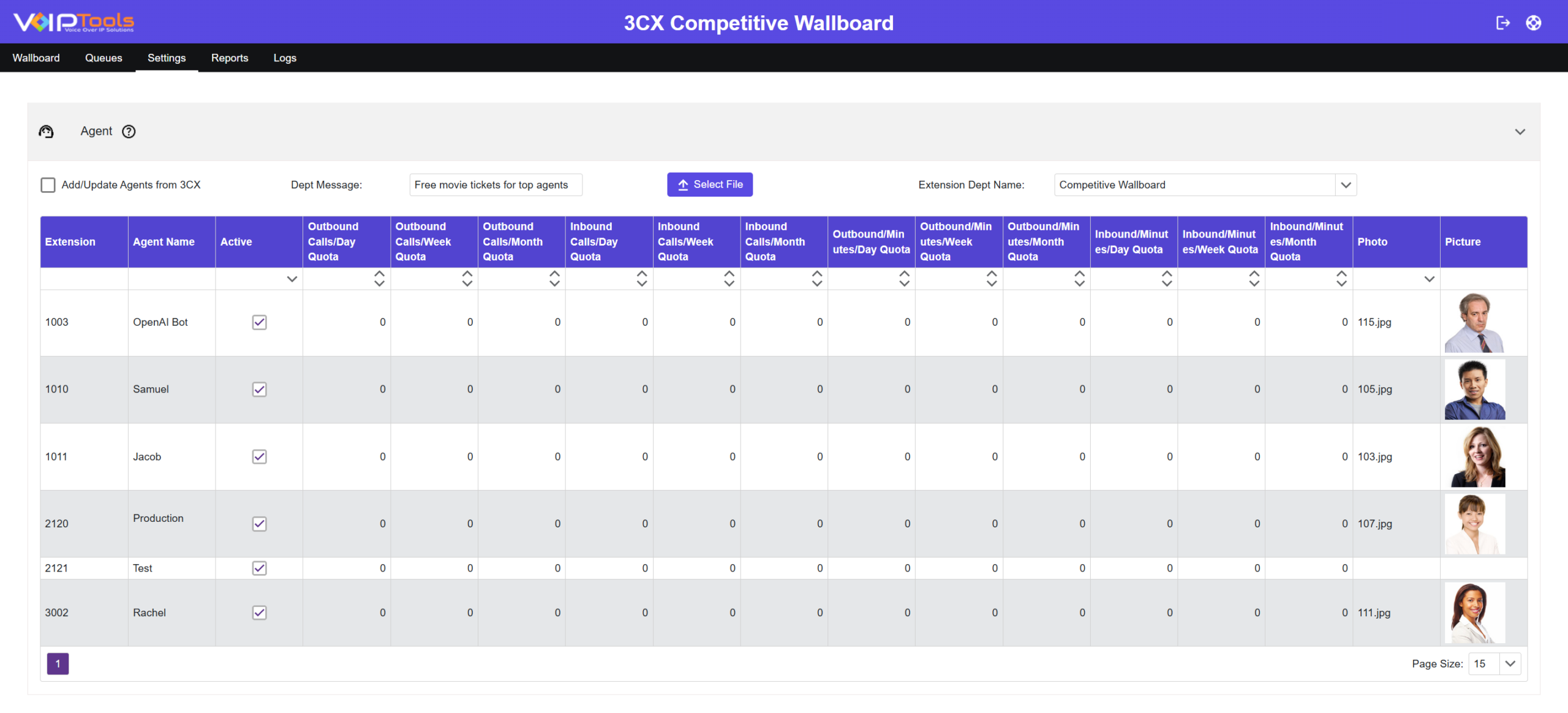
The Agent tab lets you manage every agent shown on your Wallboard, active or not. Sync agent data from 3CX, turn agents on or off, set call and minute quotas, upload photos, and set a message for the department.
Pick a department #
In the Agent tab, select a department from Extension Dept Name to load its agents into the grid.
Load agents from 3CX #
Check Add/Update Agents from 3CX to pull agent names into the grid.
This updates the names for every agent in the list, not just one.
Activate or deactivate an agent #
Check Active to turn an agent on. Clear it to turn an agent off.
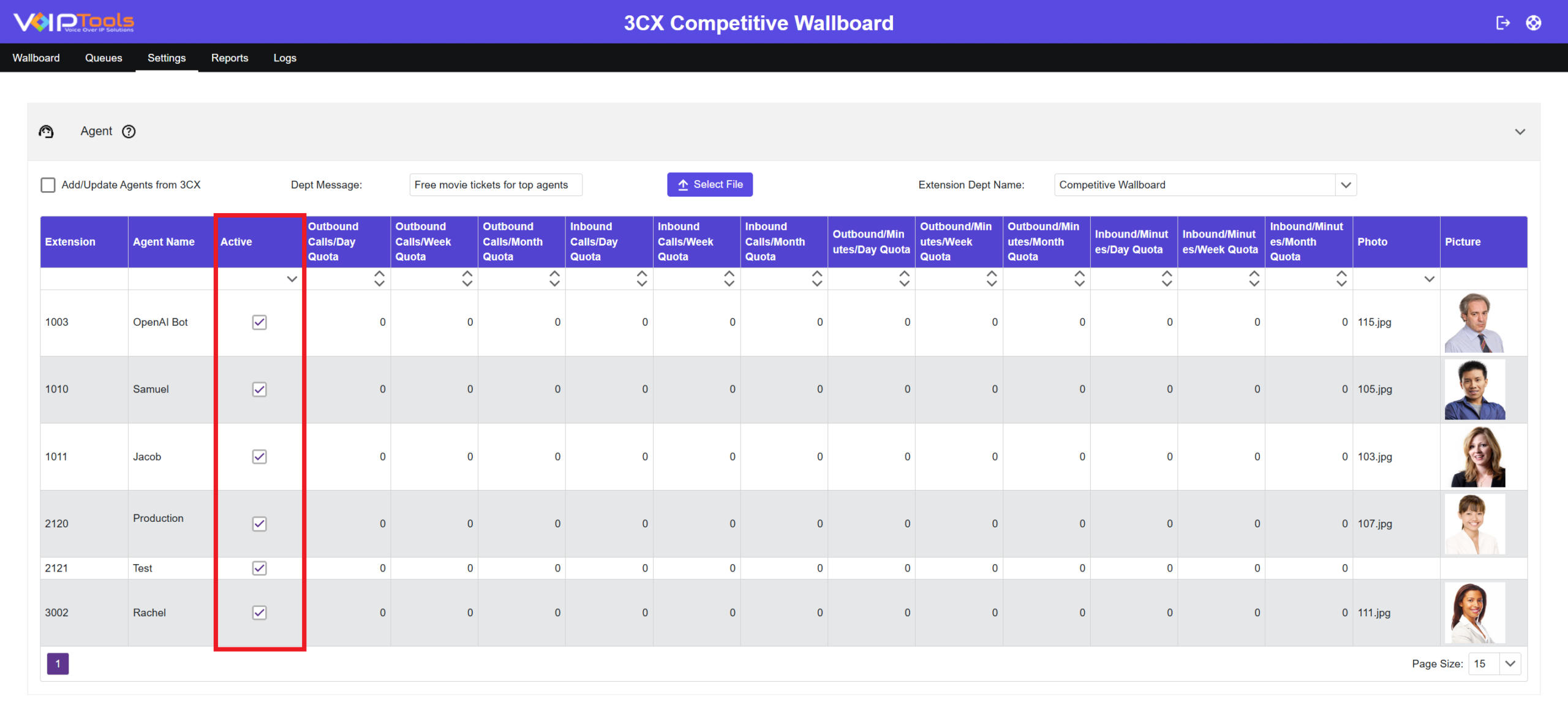
Open the Wallboard screen to confirm. An active agent shows in the list. An inactive agent does not.
Set call and minute quotas #
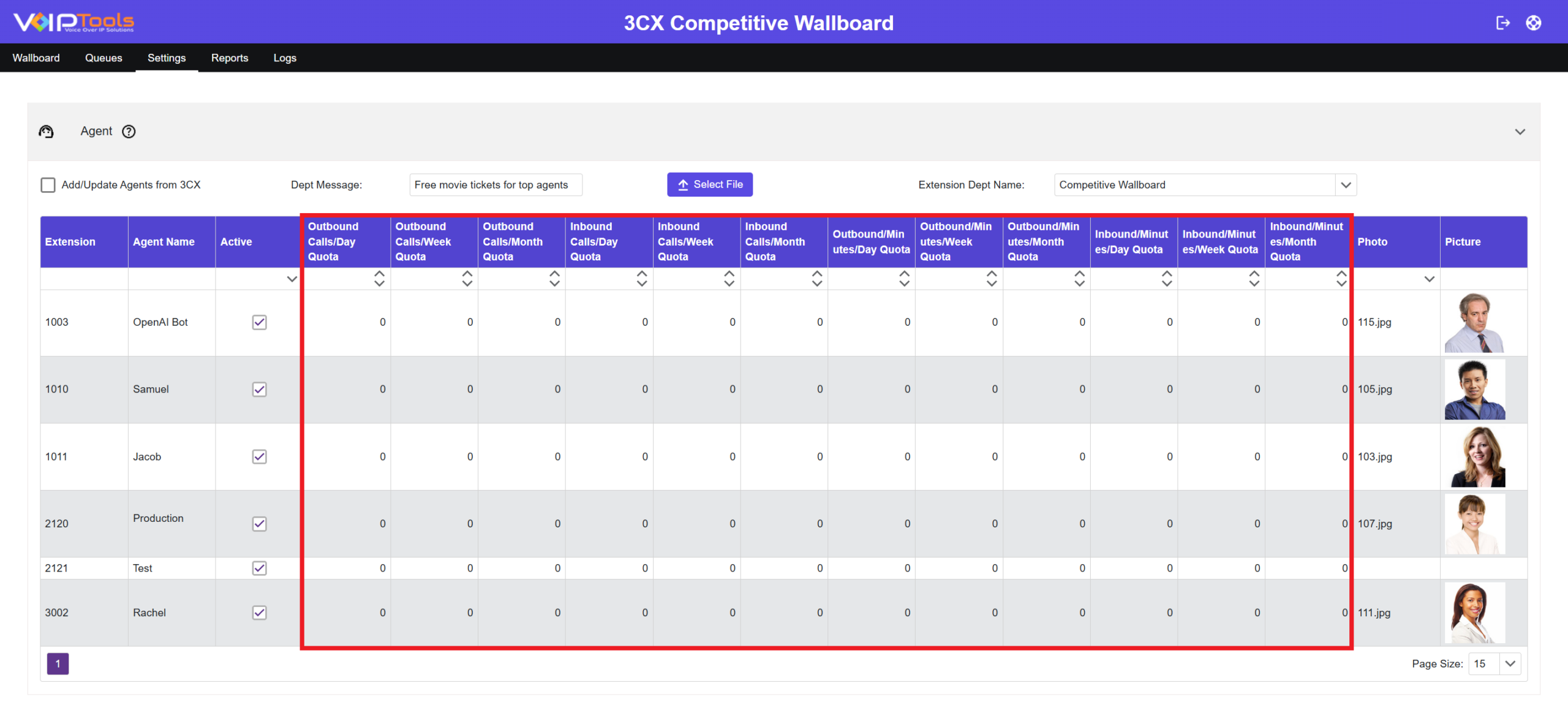
Each cell sets one number for one agent, for one time range. Type a number in the cell to set that agent’s quota for outbound calls, inbound calls, outbound minutes, or inbound minutes, for the day, week, or month.
Calls quotas count the number of calls. Minutes quotas count calling time.
Upload agent photos #
Click Select File to upload agent photos as a batch.
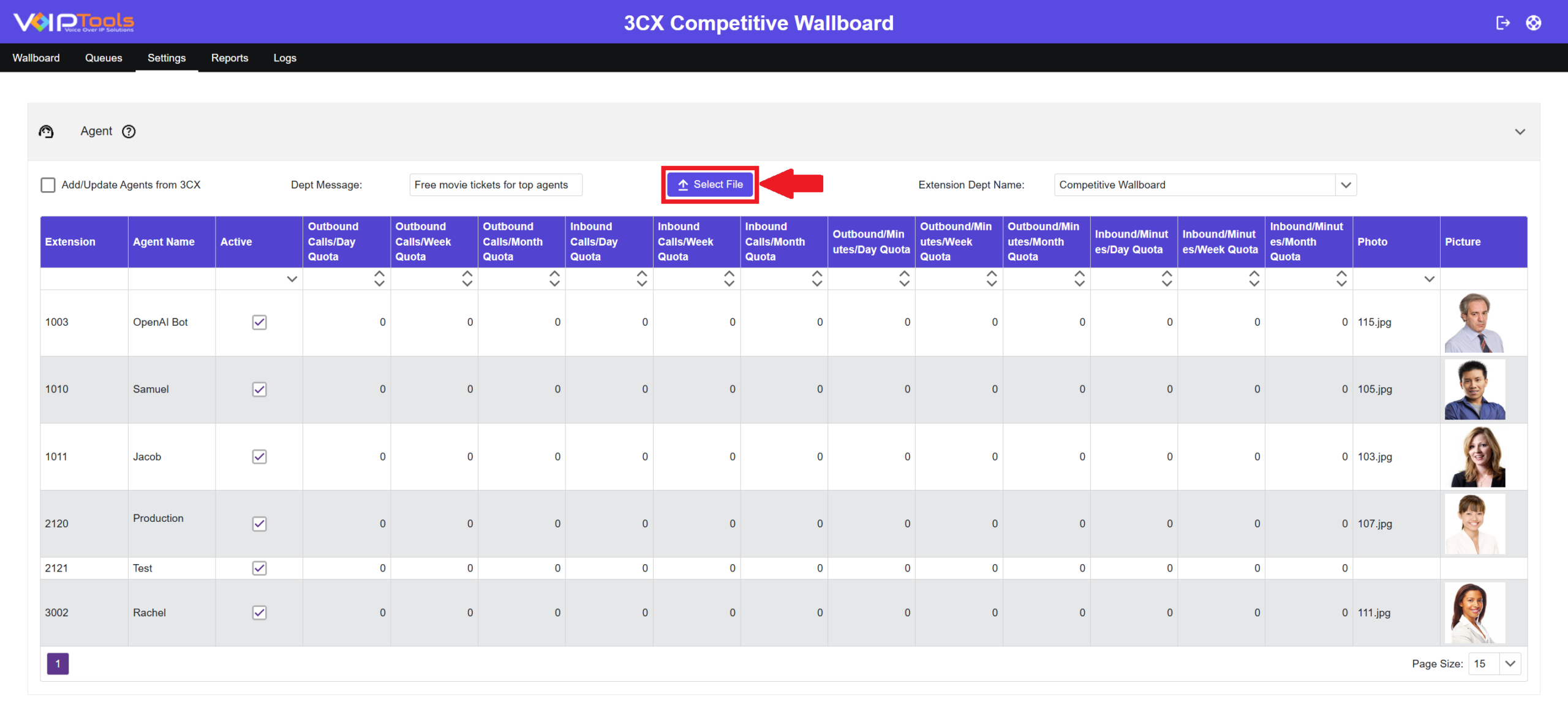
The Photo column shows the file name. The Picture column shows the image itself. Click a picture in the grid to replace that one photo.
Sort and filter the grid #
In the agent grid, select a column header to sort by that column. Select the filter icon in the column-header row to narrow the list to specific values.
Set a department message #
Type a message in Dept Message for the department picked in Extension Dept Name.
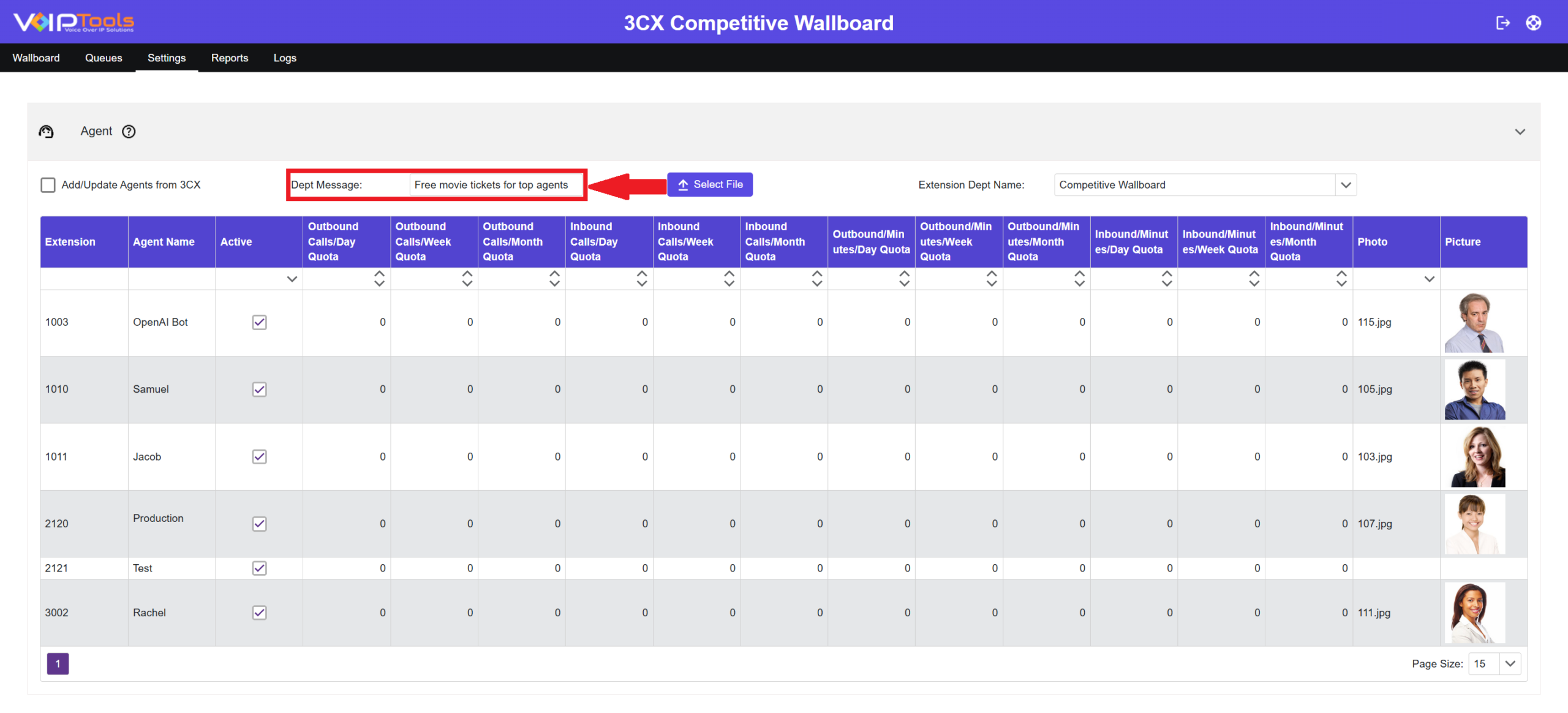
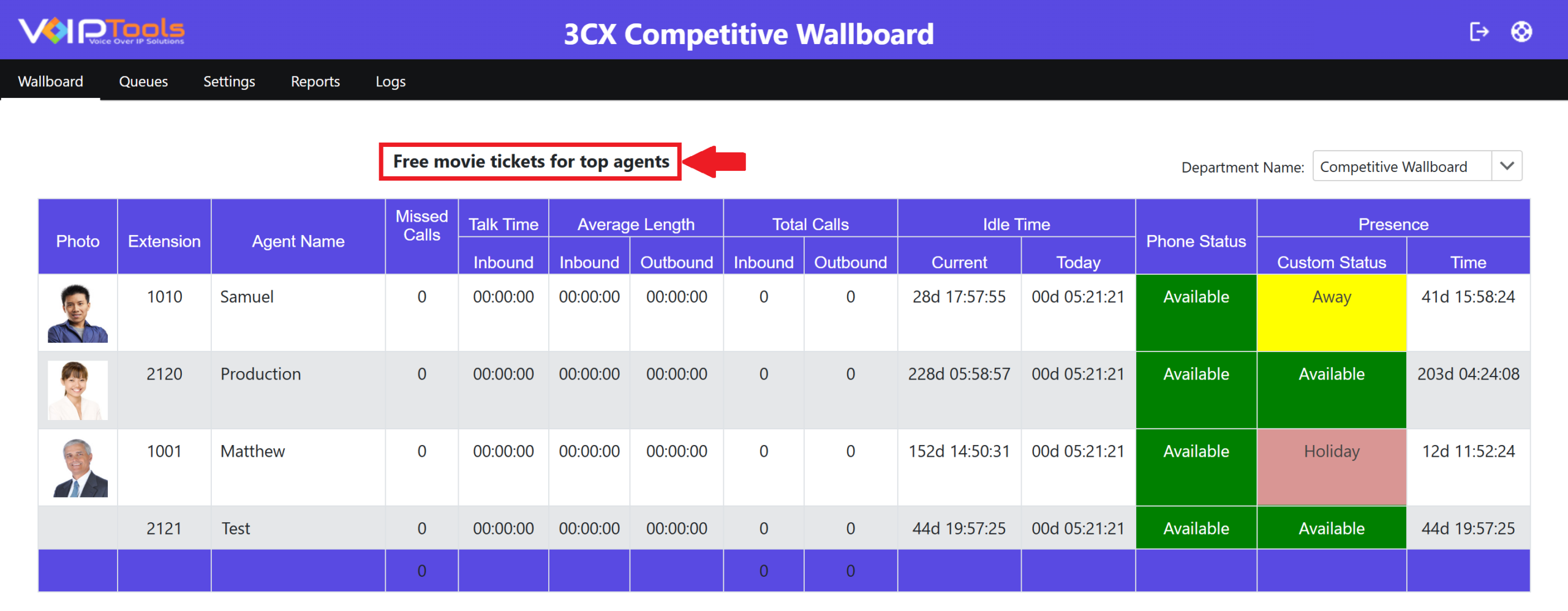
This message shows as a banner on the Wallboard for that department.
Roles #
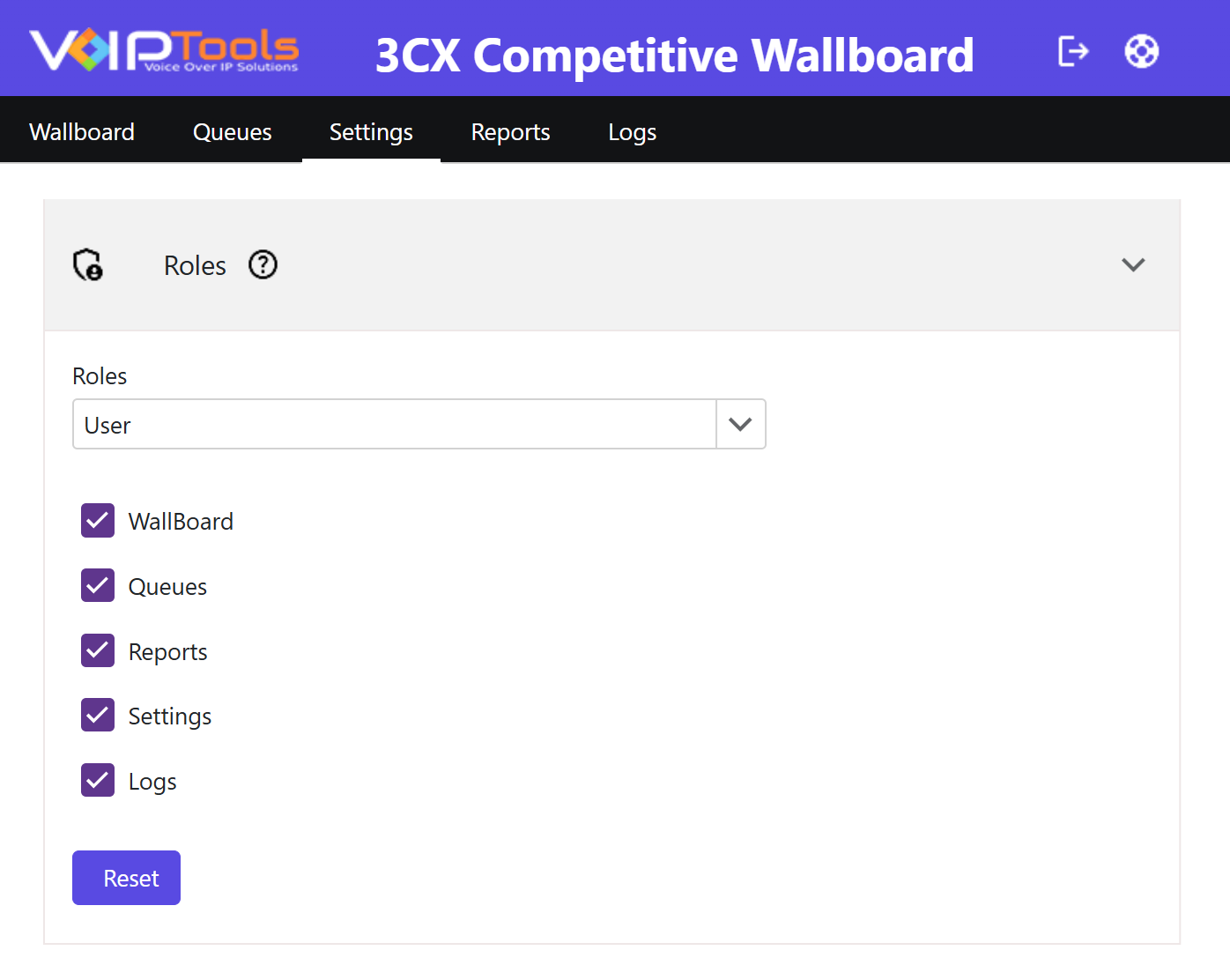
The Roles tab controls what each type of user can see and do in the Wallboard portal. Pick a role, then choose which pages that role can reach.
Pick a role #
Pick a role from Roles to load its permissions.
| Role | What it can do |
|---|---|
| User | Reaches Wallboard and Queues by default. Turn on the checkboxes below to add Settings, Reports, or Logs. |
| Receptionist | Reaches Wallboard and Queues by default. Turn on the checkboxes below to add Settings, Reports, or Logs. |
| Supervisors | Reaches every page. Can watch queues and manage team settings. |
| Department Administrator | Reaches every page. Manages settings for the people in their department. |
| Manager | Reaches every page. Sees data and reports across the whole department. |
| Owner | Reaches most of the portal. Can also change other users’ settings. |
| System Administrator | Reaches every page and setting, across the whole system. Manages users for everyone. |
| System Owner | The highest level of access. Reaches and manages every setting, log, report, and advanced configuration. |
Choose what a role can reach #
Check a box to open that page to the selected role. Clear a box to close it off. The five boxes match the five tabs at the top: Wallboard, Queues, Settings, Reports, and Logs.
Reset a role to its defaults #
Click Reset to put the selected role’s checkboxes back to their starting state.
| Role | Starting state after Reset |
|---|---|
| System Administrator, System Owner, Department Administrator, Manager, Owner, Supervisors | Every box checked |
| User, Receptionist | Wallboard and Queues checked. Settings, Reports, and Logs clear. |
Reset changes the role picked above alone. Other roles keep their own settings.
Custom Branding #
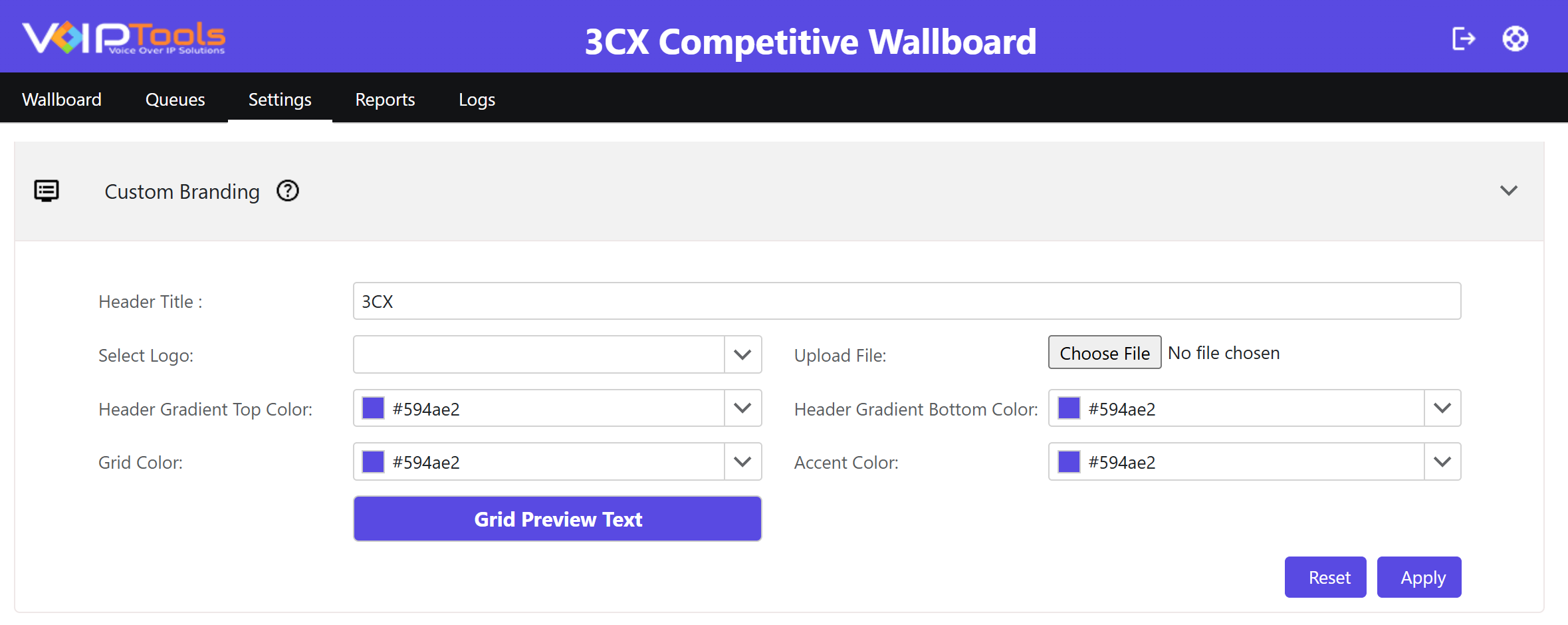
Custom Branding lets you match the Wallboard to your company’s look. Set a title, upload a logo, and pick colors for the header, grid, and text.
Set the header title
In the Custom Branding tab, enter a title in Header Title. The title appears at the top of the page.
Upload or select a logo
In Select Logo, select Choose File to upload a logo from your device. To use an existing logo, select it from Select Logo.
Set the header gradient colors
Header Gradient Top Color sets the color at the top of the header. Header Gradient Bottom Color sets the color at the bottom. Select a color box to open the color picker, then select a color.
A gradient is a smooth transition from one color to another.
Set the grid color
Grid Color sets the background color of grids throughout the app, such as those on the Wallboard and Agent tabs. Select the color box to open the color picker, then select a color. Grid Preview Text shows how the selected color looks.
Set the accent color
Accent Color sets the color of text headers throughout the app. Select the color box to open the color picker, then select a color.
When you’ve finished making changes, select Apply to save them.
To discard your changes and restore the settings you had before, select Reset.
Wallboard #
The Wallboard screen shows your team’s call activity in real time. It updates as calls come in and go out.
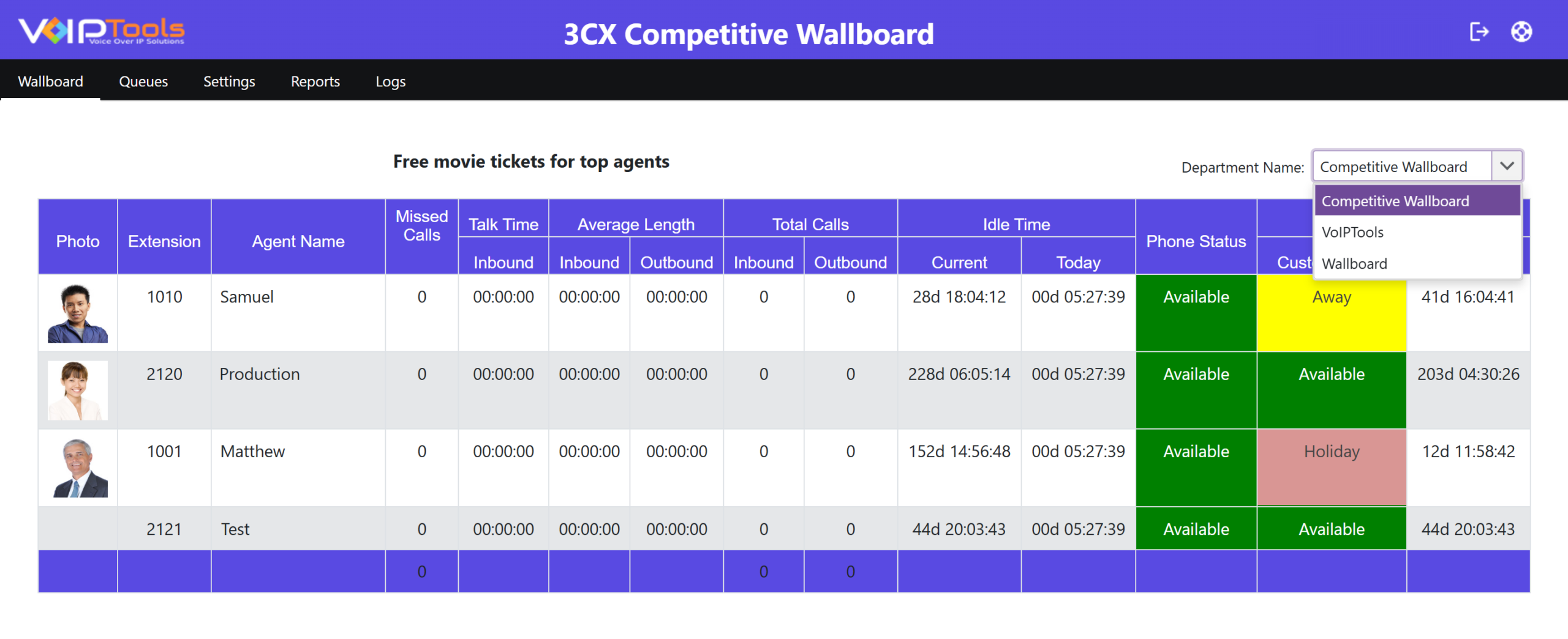
Pick a department #
Select a department from Department Name to see its agents.
A message set in Dept Message on the Agent tab appears above the grid for that department as shown in Figure 50 and 51.
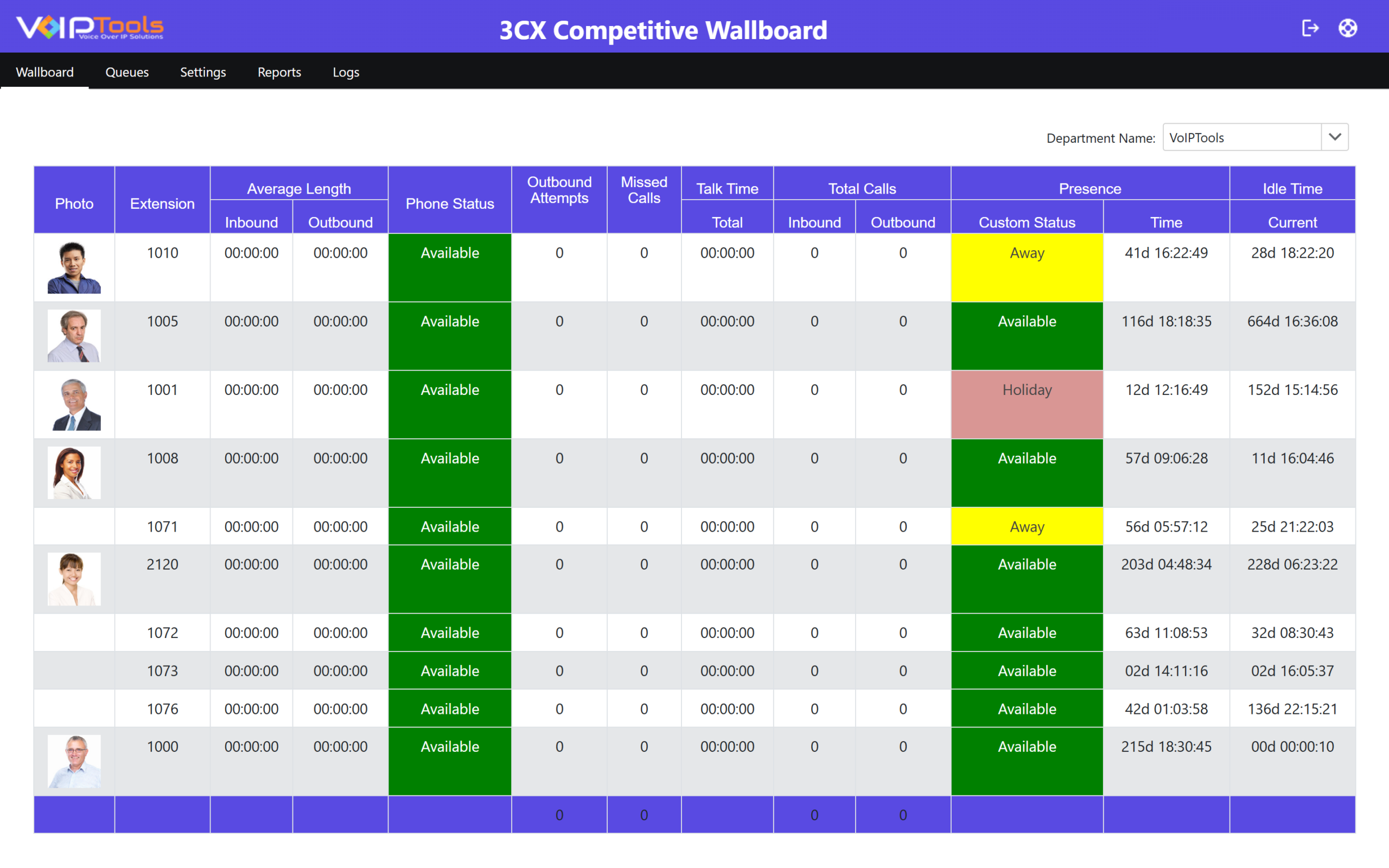
What each column shows #
| Field | Definition |
|---|---|
| Agent identification | |
| Photo | The agent’s profile picture, stored in 3CX or uploaded on the Agent tab. Shown as a thumbnail in each row. |
| Extension | The agent’s phone line number, for example 1310, 6566, or 2120. Used to route calls to the agent. Each extension is unique. |
| Agent Name | The agent’s display name from the 3CX directory. |
| Call activity | |
| Missed Calls (Inbound) | The number of inbound calls that rang to this agent but went unanswered during the current period. |
| Talk Time (Inbound) | The total time spent on completed inbound calls during the current period, in HH:MM:SS format. |
| Average Length (Inbound) | The mean length of the agent’s inbound calls. Total inbound talk time divided by the number of inbound calls answered. |
| Average Length (Outbound) | The mean length of the agent’s outbound calls. Total outbound talk time divided by the number of outbound calls placed. |
| Total Calls (Inbound) | The number of inbound calls the agent answered during the current period. Does not include missed calls. |
| Total Calls (Outbound) | The number of outbound calls the agent placed during the current period. |
| Outbound Attempts | The number of outbound calls the agent tried to place during the current period. This can include calls that did not connect or were not answered. |
| Idle time | |
| Idle Time (Current) | How long the agent has gone without a call since their last call ended or their status changed. Resets each time the agent starts a new call or changes status. |
| Idle Time (Today) | The agent’s total idle time since midnight. Unlike Current, this does not reset between calls. It resets at midnight. |
| Status and presence | |
| Phone Status | The agent’s live line state, reported by the 3CX PBX. Common values are Available and On a Call. |
| Custom Status | The agent’s own presence state, set in the 3CX client. The agent sets it, or a schedule rule sets it for them. Common values are Available, Away, Do Not Disturb, Out of Office, and Lunch. This is separate from Phone Status. An agent can be free on their line but still marked Away. |
| Time (Presence) | How long the agent has held their current Custom Status. Resets each time the status changes. |
Agent order #
Agents on the Wallboard follow the Sort By, Sort Order, Sort By Range, and Sort Order Type settings from General settings. Refer to Figure 41.
When two agents tie on calls, the agent with more talk time for that direction shows above the other.
Totals row #
The row at the bottom of the grid adds up the totals for the columns shown above it.
Idle time and presence #
Idle Time shows how long an agent has gone without a call. Presence shows the agent’s Custom Status and how long they have held it.
Set Work hours type to Shifts in General settings to see Idle Time on the Wallboard.
Queues #
The Queues screen shows how each call queue is doing today. Pick which departments and queues to watch, then check on wait times, answered calls, and more.
This screen shows data for inbound external calls to the Call Queues alone.
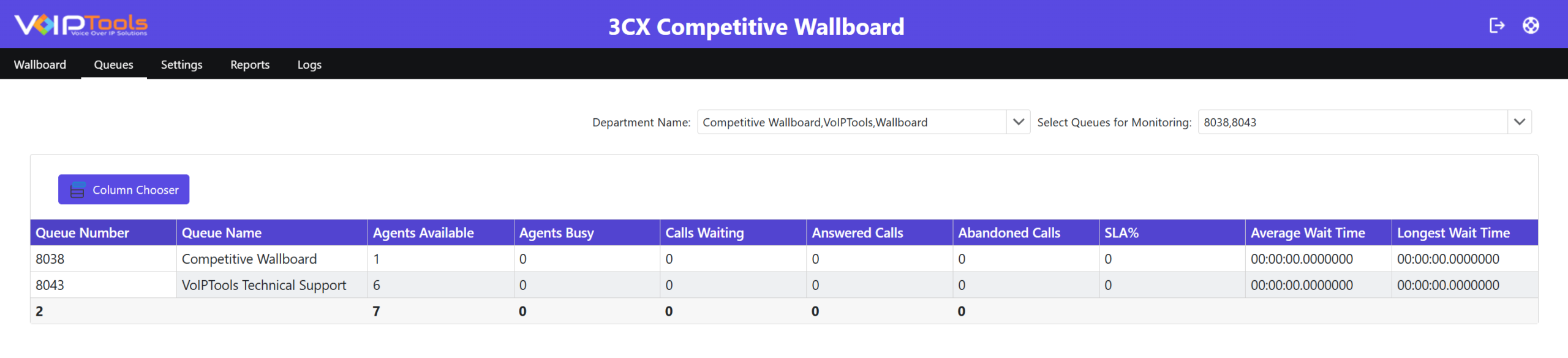
Pick departments and queues #
Select Department Name to choose one or more departments. Select Select Queues for Monitoring to pick which of those departments’ queues show in the grid.
Choose your columns #
Select Column Chooser to open the list of available columns. Select a checkbox to add that column to the grid. Clear a checkbox to remove it.
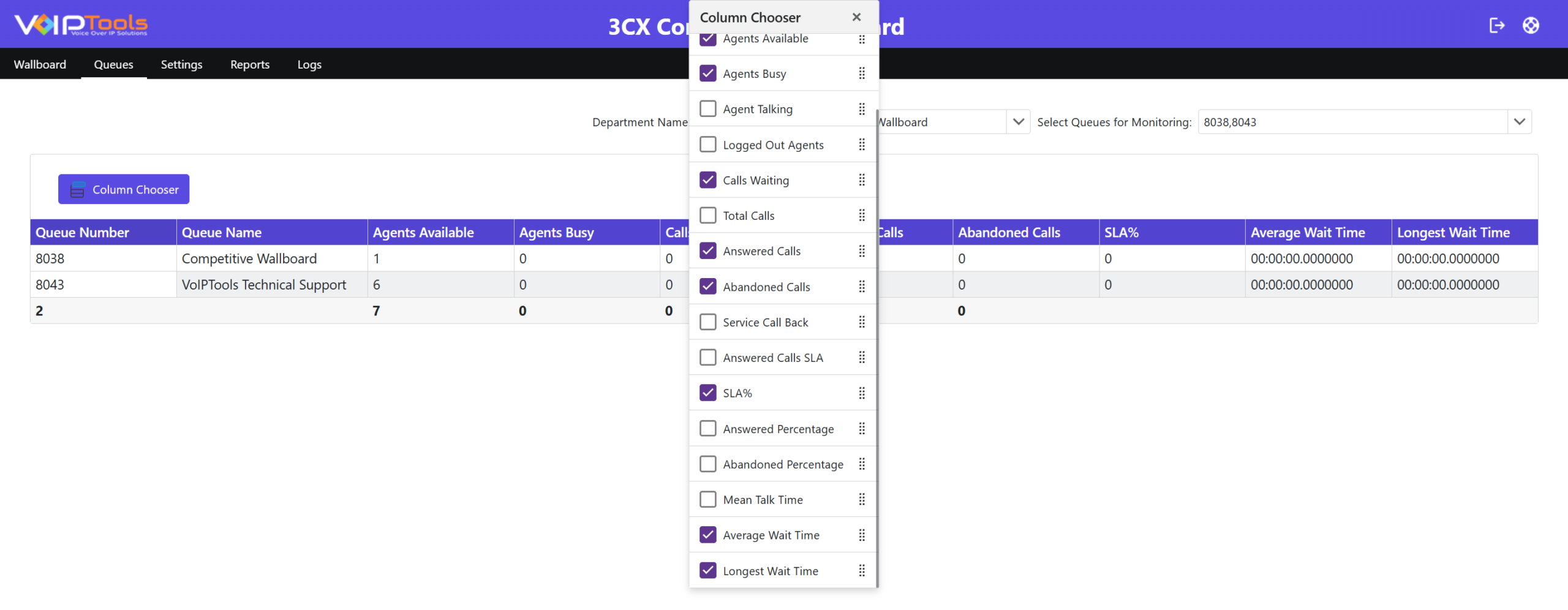
What each column shows #
The grid can display different columns depending on your configuration. The definitions below start with the columns shown in this manual’s examples, followed by the rest of the available columns.
Columns shown in this manual’s examples #
| Column | Definition |
|---|---|
| Queue Number | The number assigned to the queue in 3CX, for example 8038 or 8043. Callers reach the queue through this number. |
| Queue Name | The queue’s label in 3CX, for example Competitive Wallboard or VoIPTools Technical Support. |
| Agents Available | The number of agents in the queue ready to take a call. |
| Agents Busy | The number of agents in the queue on an active call. |
| Calls Waiting | The number of callers on hold in the queue right now. |
| Answered Calls | The number of calls in the queue an agent answered during the current period. |
| Abandoned Calls | The number of callers who hung up before an agent answered, during the current period. |
| SLA% | The percentage of calls answered within the SLA target set in General settings. |
| Average Wait Time | The average time callers wait in the queue before an agent answers, in HH:MM:SS format. |
| Longest Wait Time | The longest time any caller has waited in the queue, in HH:MM:SS format, during the current period. |
Other available columns #
| Column | Definition |
|---|---|
| Agent Talking | The number of agents on a call for this queue right now. |
| Logged Out Agents | The number of agents assigned to the queue who are logged out. |
| Total Calls | The total number of calls that entered the queue during the current period, including answered and abandoned calls. |
| Service Call Back | The number of calls in the queue handled through a callback instead of holding. |
| Answered Calls SLA | The number of answered calls that met the SLA target. |
| Answered Percentage | The percentage of calls sent to the queue that an agent answered. |
| Abandoned Percentage | The percentage of calls sent to the queue where the caller hung up before an agent answered. |
| Mean Talk Time | The average time agents spend talking with callers from this queue. |
Reports #
The Reports screen holds three reports: Call Log Report, Agent Status Report, and Queue Call Log Report. Each one lets you filter a date range, group the results, and export the data.
A role needs the Reports permission, set on the Roles tab, to see this screen.
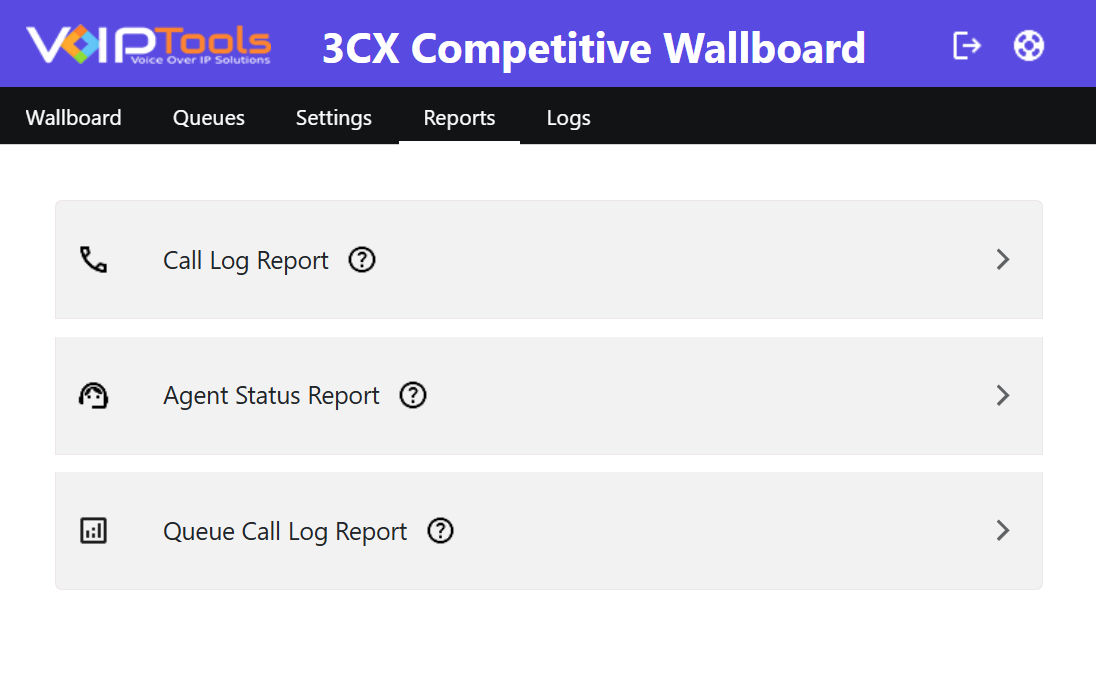
Set filters, group data, and export #
Each report tab uses the same filters, grouping, and export options.
Set your filters #
Select Start Date and End Date to set the range. Select Display Time Zone to set the zone for dates and times. Select Apply to load the report.

Group and sort the data #
Drag a column header up into the bar above the grid to group rows by that column. Select the arrows in a column header to sort by that column. Select the arrow beside a group in the grid to expand or collapse it.

Export the data #
Select an export icon to save the report as a CSV, XLS, XLSX, or PDF file.
Call Log Report columns #
The Call Log Report shows every call your agents placed or received.
| Column | Definition |
|---|---|
| Extension | The extension involved in the call. |
| Agent Name | The name of the agent involved in the call. |
| Phone Number | The phone number on the other side of the call. |
| Call Start | When the call began. |
| Call Answered | When an agent answered the call. |
| Call End | When the call ended. |
| Status | Whether the call was answered or went unanswered. |
| Direction | Whether the call was inbound or outbound. |
| Ringing | How long the call rang before it was answered or ended. |
| Talking | How long the agent and caller spent on the call. |

Agent Status Report columns #
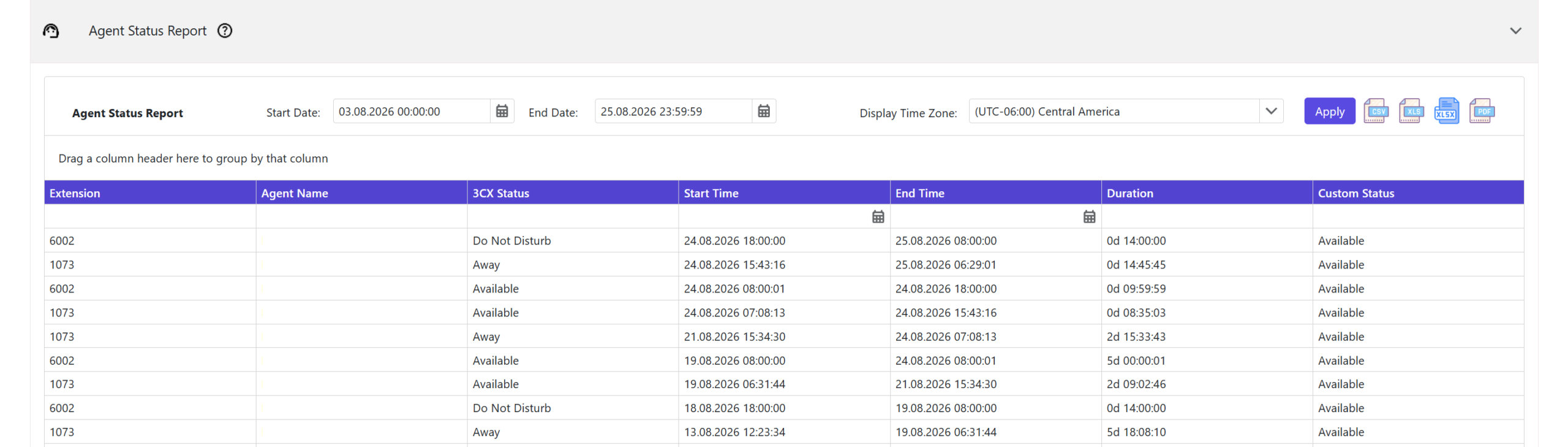
The Agent Status Report shows a history of every status change for your agents.
| Column | Definition |
|---|---|
| Extension | The extension of the agent. |
| Agent Name | The name of the agent. |
| 3CX Status | The agent’s presence state in 3CX at the time. |
| Start Time | When the agent entered this status. |
| End Time | When the agent left this status. |
| Duration | How long the agent stayed in this status. |
| Custom Status | The agent’s custom status, set in 3CX Custom Presence. |
Queue Call Log Report columns #
The Queue Call Log Report shows every call that entered a queue.
| Column | Definition |
|---|---|
| Queue Number | The number of the queue the call entered. |
| Start Time | When the call entered the queue. |
| End Time | When the call left the queue. |
| Servicing Time | The total time the call was being handled, from connection to end. |
| Wait (seconds) | How long the caller waited in the queue, in seconds. |
| Ring Time | How long the call rang before it was answered. |
| Talk (seconds) | How long the agent and caller spent on the call, in seconds. |
| No Answer Code | A code the system logs when the call went unanswered. |
| Fail Code | A code the system logs if the call failed to connect. |
| Call History ID | The unique ID 3CX assigns to the call. |
| From User | The number of the person who called. |
| From Display Name | The caller’s name, if 3CX has one on file. |
| To DN | The extension the call reached. DN is short for directory number, another term for an extension. |
| Callback Number | The number the system calls back, for callback requests. |
| Answered | Whether an agent answered the call. |
| Is Callback | Whether the call was a callback instead of a caller holding. |
| CDR Participant ID | The unique ID 3CX assigns to this leg of the call. CDR is short for call detail record, the system’s log entry for a call. |

Logs Menu #
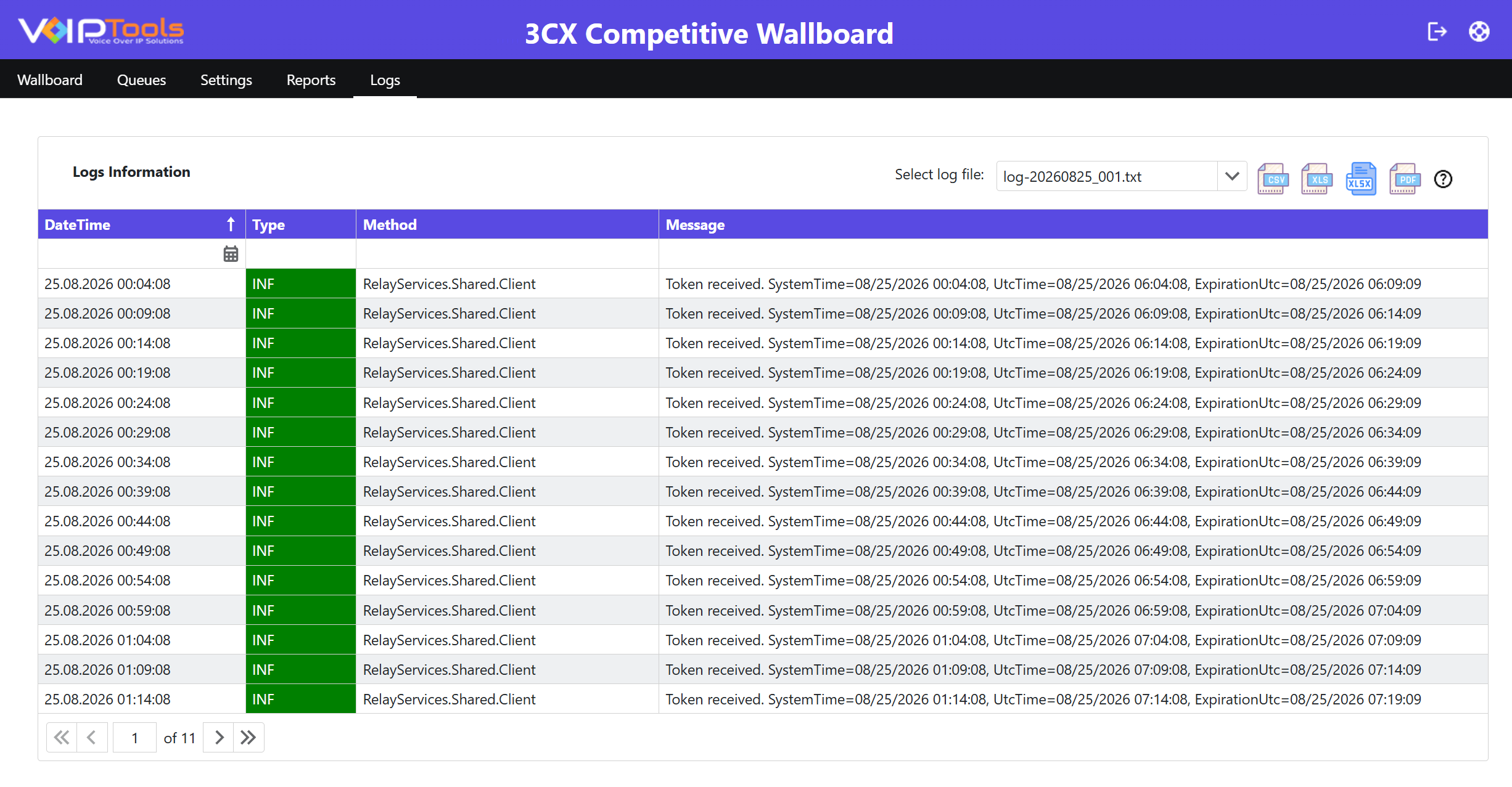
The Logs Menu lets you view the login and logout events of all the sessions along with ‘Date’ and ‘Time’ that is according to the time zone set in the ‘Web Portal’ tab in Settings menu.
Field Definitions
| Field | Definition |
|---|---|
| Logs Information Table | Displays system events and activity records used for monitoring, troubleshooting, and auditing. It helps users review application behavior, track system actions, and identify issues based on the selected log file. |
| Date/Time | Displays the date and time when the log event occurred based on the system-generated timestamp. |
| Type | Indicates the category or severity level of the log entry to help identify the nature of the event: INF = Informational (normal activity), WRN = Warning (potential issue), ERR = Error (system issue or failure). |
| Method | Displays the system component, process, or function where the log event originated. |
| Message | Shows detailed information about the recorded event, including actions performed, warnings, errors, or system responses. |
| Select Log File | Allows you to select a specific log file to view its recorded events. Example is log-20260520. |
| Page Size | Defines the number of log entries displayed per page. |
Create 3CX Extension Group #
#
A 3CX Extension Group is needed to identify which extensions should be monitored for outbound call activities. A Wallboard manager is created by assigning the ‘manager’ role to a specific extension in the extension group.
#
You can create an extension group and assign multiple extensions to it.
#
A single extension can exist in more than one extension group.
#
-
- Login to 3CX Console Management as a Manager.
-
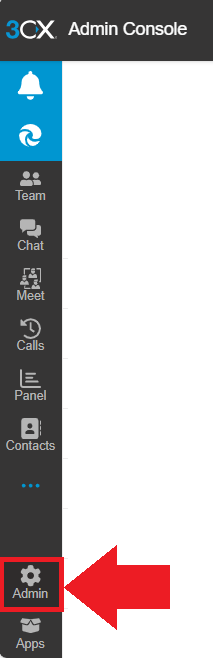
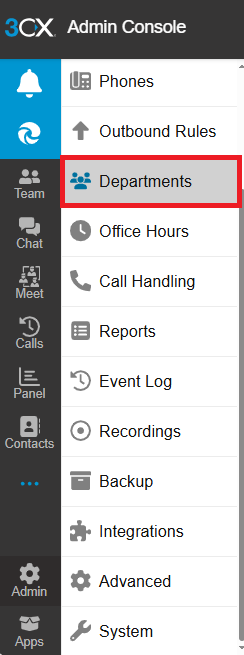
- Click Admin menu in the In the Left Side Panel.
#
#
-
- Click to open the Departments tab.
#
#
-
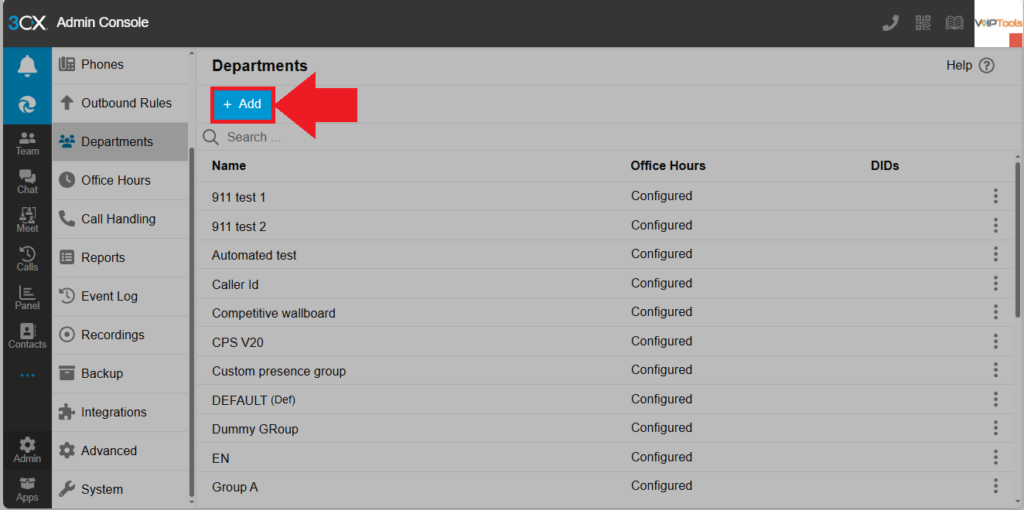
- Click the Add button to add a new extension group.
#
#
-
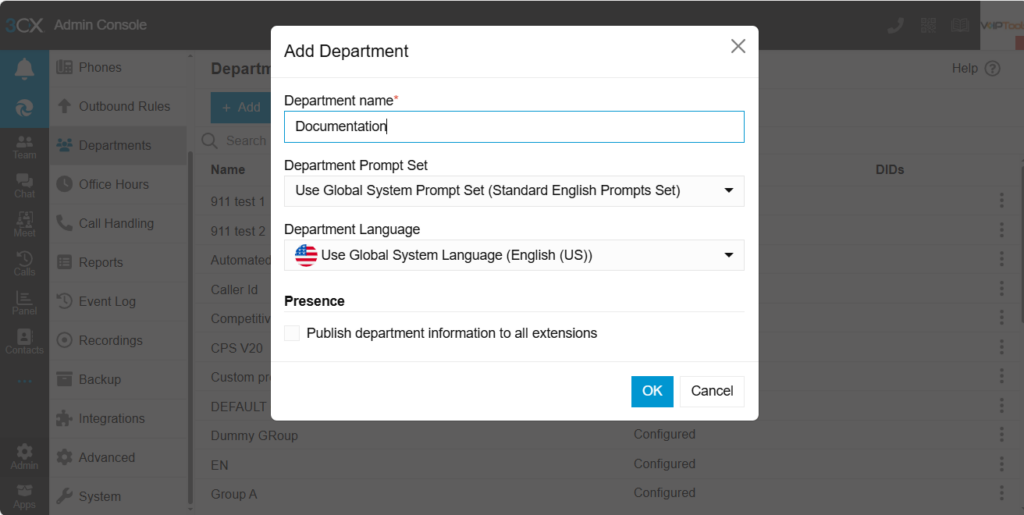
- Enter the group name in the Department Name field and click the OK button.
#
#
-
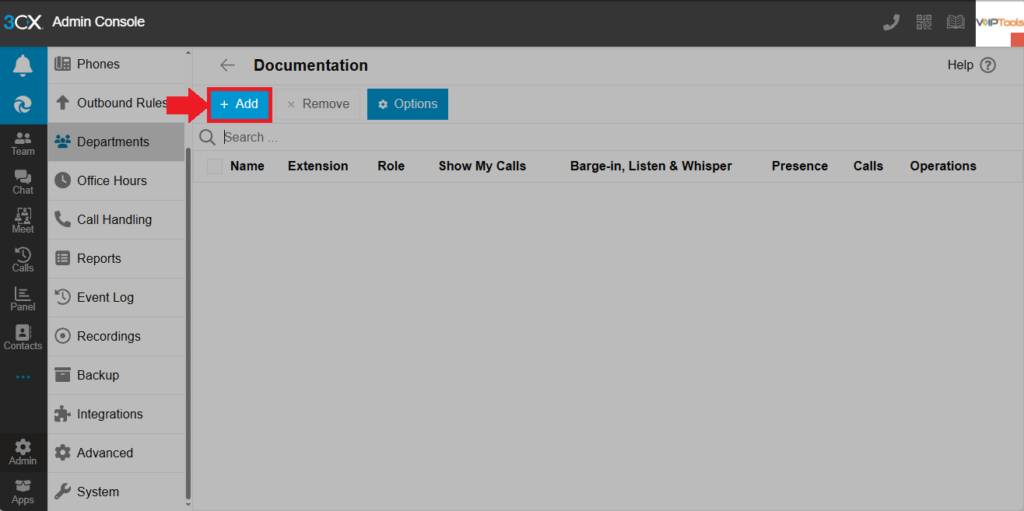
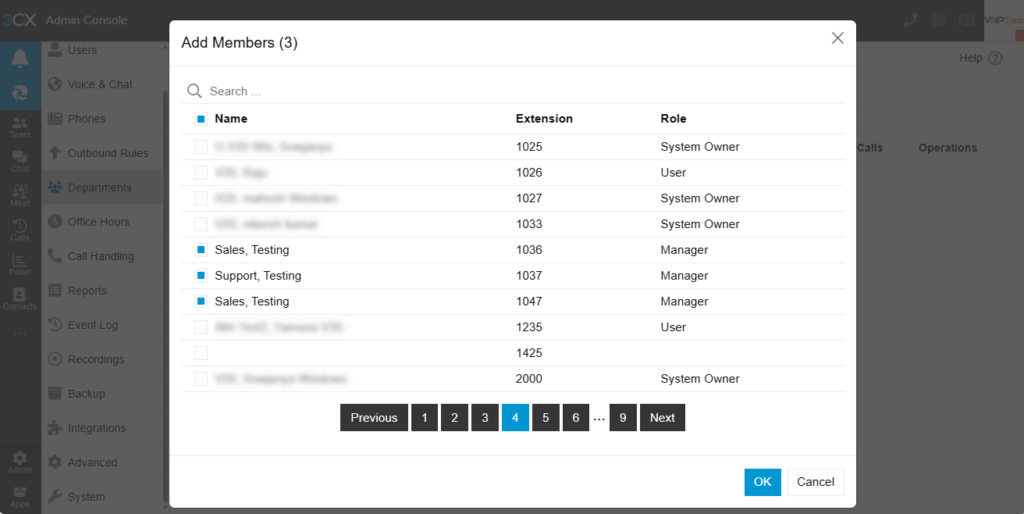
- Click the Add button to add extensions to your group.
#
#
-
- Select the desired extensions and click the OK button.
#
#
-
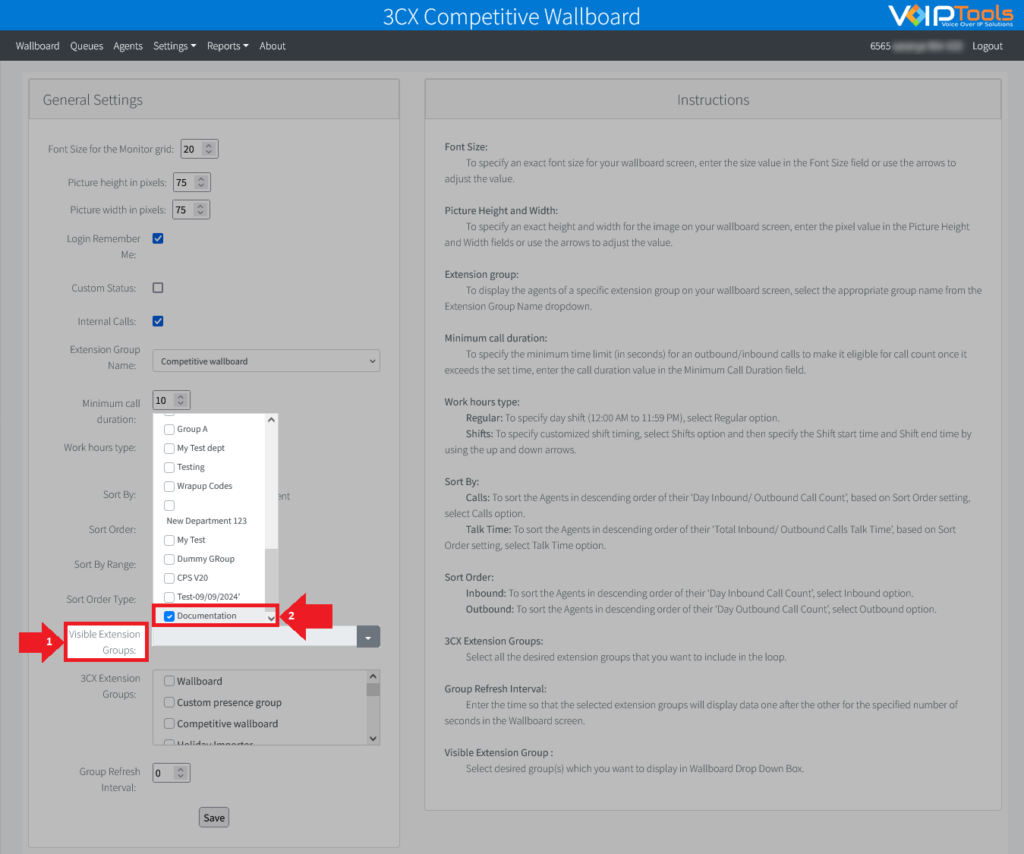
- Switch to the Competitive Wallboard web application and navigate to the General Settings screen.
-
- In the Visible Extensions Groups dropdown, select the extension group created to display in the Wallboard tab.
#
#
-
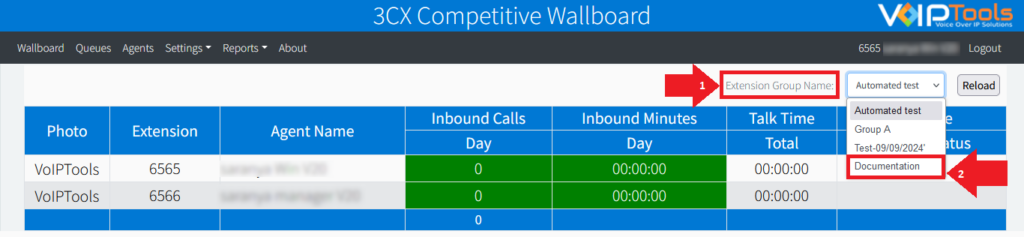
- Navigate to the Wallboard tab and in the Extension Group Name dropdown, select the group created.
#
#
You can see the created extension group with all the extensions displayed in the Wallboard tab.
#